



You have a limited marketing budget. You have two proven channels in front of you. And you have one decision to make — because splitting a small budget across both usually means doing neither well.
The SEO vs PPC debate is one of the most searched questions in digital marketing, and the honest answer is the one nobody wants to hear: it depends. But “it depends” is only a useful answer if you know exactly what it depends on.
That’s what this guide delivers. We’ll compare costs, timelines, and returns for both channels, walk through when each one wins, and then hand you a five-question decision framework you can apply to your business today. By the end, you won’t be shrugging — you’ll have an actual answer, backed by your own numbers, not someone else’s opinion.
Let’s settle this properly.
SEO vs PPC — The Quick Answer
Start with PPC if: you need revenue in the next 30–90 days, you’re validating a new offer or product, or your customers search with high buying intent and you can afford the click costs.
Start with SEO if: you have a 6–12 month runway before you need the channel to pay for itself, your niche has strong informational search demand, and you want a compounding asset that keeps producing traffic without a per-click bill.
The long-term reality: most successful businesses eventually run both. PPC buys you speed and data; SEO buys you durability and margin. The real question isn’t which one — it’s which one first.
What’s the Real Difference Between SEO and PPC?
Both channels put your business in front of people searching on Google. The difference is how you earn that placement — and everything about cost, speed, and longevity flows from that.
How SEO works
Search engine optimisation earns your website visibility in the organic (unpaid) results. Google ranks pages based on relevance, content quality, technical health, and authority — largely measured through helpful content and links from other credible sites. SEO is a build: you publish content, improve your site, earn authority, and rankings accumulate over months. Nothing is paid per click. Once a page ranks, it can generate traffic for years with maintenance rather than ongoing media spend.
How PPC works
Pay-per-click advertising (primarily Google Ads) works on a live auction. You bid on keywords, and when someone searches, Google runs an instant auction weighing your bid and your ad quality. Win, and your ad appears at the top of the page — immediately, from day one. You pay only when someone clicks. Turn the budget on, traffic flows. Turn it off, traffic stops the same hour.
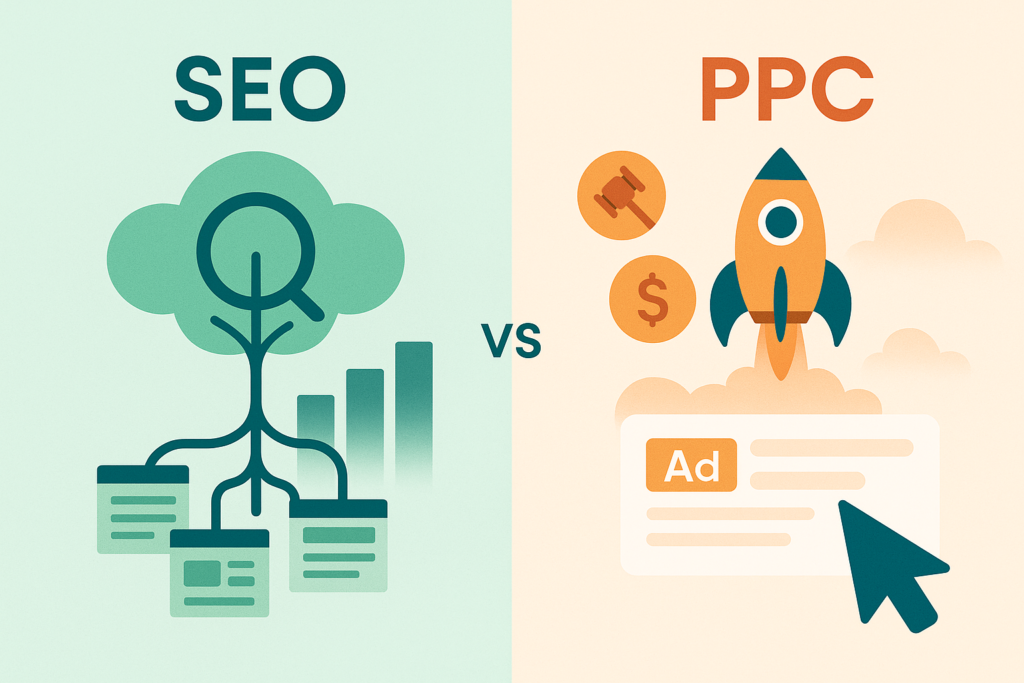
SEO vs PPC at a glance
| Factor | SEO | PPC |
|---|---|---|
| Cost model | Upfront investment in content, links, technical work — no per-click cost | Pay per click, forever, plus management costs |
| Speed to results | Typically 4–12 months | Hours to days |
| Longevity | Compounds; rankings persist after work slows | Stops the moment budget stops |
| Trust factor | Higher — users trust organic results more | Lower — clearly labelled as ads |
| Scalability | Scales with content and authority, not linearly with spend | Scales instantly with budget (rising cost per click at scale) |
| Skill requirements | Content, technical SEO, digital PR | Bid management, ad copy, landing page CRO |
The Case for Starting with PPC
PPC’s core promise is simple: revenue this month, not next year. For plenty of businesses, that alone decides the argument.
Speed to revenue. A well-built Google Ads campaign can be driving qualified visitors within 48 hours of launch. If cash flow is tight or investors want traction, no other search channel comes close.
Precise targeting. You choose exactly which keywords trigger your ads, which locations see them, what time of day they run, and which devices they appear on. You can bid only on “emergency plumber Chennai” and ignore everything else. SEO can’t be that surgical.
Instant market data. Within weeks, PPC tells you which keywords actually convert, what a lead costs, and which messaging resonates. This data would take SEO a year to surface — and it’s gold when you eventually invest in organic content, because you’ll build pages around keywords that are proven to make money.
Effortless A/B testing. Headlines, offers, landing pages, prices — PPC lets you test variations side by side with statistically meaningful traffic in days.
Predictable scaling. Once you know a click costs ₹80 and converts at 4%, growth becomes arithmetic. Double the budget, roughly double the leads.
PPC-first is the right call for: brand-new businesses with no domain authority, product launches with a hard deadline, founders validating whether an offer converts at all, and high-lifetime-value services (legal, B2B SaaS, healthcare) where even expensive clicks pay back many times over.
The Case for Starting with SEO
If PPC is renting traffic, SEO is buying the building. The rent never ends; the mortgage eventually does.
A compounding asset. Every article published, every link earned, every ranking gained stacks on top of the last. A page that ranks #1 today can still be sending you free customers in three years. PPC delivers nothing after the last click is paid for. This is the fundamental economic difference — SEO spend builds equity, PPC spend buys inventory.
Lower long-term cost per acquisition. SEO costs more per lead in months 1–6 and dramatically less from month 12 onward. Once content ranks, the marginal cost of the next visitor approaches zero, while PPC’s cost per click typically rises year over year as competition grows.
Trust and credibility. Users know the difference between ads and organic results, and the majority of clicks on most search results pages go to organic listings. Ranking naturally signals authority in a way a paid placement can’t.
Resilience. When budgets get cut — a slow quarter, a recession, a cash crunch — PPC-dependent businesses watch their pipeline vanish overnight. Organic traffic keeps flowing whether or not you spent money that month.
SEO-first is the right call for: businesses with 6–12 months of runway, content-friendly niches where customers research before buying, local service businesses (where Google Business Profile and local SEO deliver outsized returns at low cost), and markets with heavy informational search demand you can capture with helpful content.
Cost Comparison — What Will You Actually Spend?
Vague “it varies” answers help nobody, so here are realistic ranges.
Typical PPC costs
Cost per click depends heavily on industry. Broad benchmarks: e-commerce and retail keywords often run $1–3 (₹80–250) per click, home services $5–15, B2B software $10–30, and legal or insurance keywords can exceed $50 per click in competitive Western markets. In India, CPCs are generally lower but climbing fast in competitive verticals.
On top of media spend, budget for management: agencies typically charge 10–20% of ad spend or a flat monthly fee ($500–2,000+ / ₹25,000–1,00,000+). As a rule of thumb, a minimum viable PPC budget is one that can buy at least 100–200 clicks per month in your niche — enough to generate conversion data you can actually act on. Below that, you’re guessing.
Typical SEO costs
Professional SEO retainers commonly range from $1,000–5,000 per month (₹40,000–2,00,000 in the Indian market) depending on competitiveness and scope. That typically covers strategy, technical fixes, content production (the biggest line item — quality articles cost real money to produce), and link building. Expect 6–12 months to break even and 12–24 months for the channel to hit full stride.
A simple 12-month illustration
Assume $2,000/month in either channel, with leads worth $200 each:
| Months 1–3 | Months 4–6 | Months 7–9 | Months 10–12 | 12-month total | |
|---|---|---|---|---|---|
| PPC — leads/mo | 15 | 18 | 20 | 20 | ~220 leads |
| SEO — leads/mo | 1 | 5 | 15 | 30 | ~150 leads |
PPC wins year one. But run the same table into year two: PPC stays flat at ~20 leads/month for the same spend, while SEO’s monthly leads keep climbing — and would continue arriving even if you cut the retainer. The crossover point for most businesses lands somewhere between month 12 and 18.
The Decision Framework — 5 Questions to Ask
Answer each question honestly, choosing A or B. Tally your answers at the end.
1. How fast do you need revenue from this channel?
- A: Within 90 days — we need pipeline now.
- B: We can wait 6–12 months if the long-term return is better.
2. What’s your realistic monthly budget?
- A: Enough to buy meaningful click volume in my niche (media spend plus management) — and enough landing-page quality to convert it.
- B: Modest but sustainable — I can commit $1,000–3,000/month consistently for a year, but competitive CPCs would eat a paid budget alive.
3. How does your customer search — transactional or research-heavy?
- A: Transactional. They search “buy,” “near me,” “price,” “hire” — and they’re ready to act. High-intent keywords reward paid placement.
- B: Research-heavy. They compare, read guides, and educate themselves for weeks before buying. That’s a content opportunity ads can’t fully capture.
4. How competitive is your niche — organically vs in the ad auction?
- A: The organic results are dominated by giant, established sites I can’t realistically outrank soon — but CPCs are affordable.
- B: CPCs in my niche are brutal, but the organic content out there is thin, outdated, or generic — I can genuinely do better.
5. Do you have (or can you produce) content assets?
- A: No writer, no subject-matter time, no appetite for publishing regularly.
- B: Yes — we have expertise, stories, data, or a team that can produce genuinely helpful content consistently.
Scoring:
- Mostly A answers → start with PPC. You need speed, your buyers show purchase intent, and paid search fits your constraints.
- Mostly B answers → start with SEO. You have runway, a research-driven audience, and the raw material for content that compounds.
- A near-even split → start with a lean PPC campaign to generate revenue and keyword data, and reinvest a fixed slice of that revenue into SEO from month one.
Why the Smartest Businesses Use Both (Eventually)
Framing SEO vs PPC as a permanent either/or is a beginner’s mistake. Mature marketing teams run them as a system, because each channel makes the other better.
PPC data feeds SEO strategy. Your ads reveal exactly which keywords convert and which headlines get clicked. Build SEO content around those proven winners and you remove most of the guesswork from your content roadmap.
SERP domination. Ranking #1 organically and holding the top ad spot means you own two of the most visible positions on the page. Studies consistently show the combination lifts total clicks beyond what either placement earns alone — and it pushes competitors further down.
Remarketing organic visitors. Most first-time organic visitors leave without converting. Retargeting ads bring them back for a fraction of a cold click’s cost, turning SEO traffic into a paid audience you can nurture.
Seasonality balancing. Scale ads up during peak buying seasons and let organic carry the baseline the rest of the year, keeping acquisition costs stable across cycles.
The sequencing question this guide answers is about year one. By year two, the goal is both.
Common Mistakes to Avoid With Either Channel
Quitting SEO at month three. SEO’s hardest stretch is months 2–5, when you’re spending but not yet ranking. Abandoning it there means paying full price and collecting zero returns — the compounding was just about to start.
Sending PPC traffic to weak landing pages. Great ads pointed at a slow, cluttered, unpersuasive page simply buy expensive bounces. Fix the page before scaling the spend.
Choosing on cost alone. The cheaper channel that doesn’t fit your buyer’s behaviour is the expensive one. Cost per customer is the only number that matters.
Skipping conversion tracking. Running either channel without proper tracking is spending money blindfolded. Set up conversion tracking and analytics before the first rupee or dollar goes out.
FAQ
Is SEO cheaper than PPC in the long run? Usually, yes. SEO costs more upfront with no immediate return, but once rankings are established, your cost per acquisition falls steadily because you’re no longer paying per visitor. PPC’s cost per lead tends to stay flat or rise over time as auction competition increases. The crossover typically arrives 12–18 months in.
How long does SEO take to work? Most websites see meaningful movement in 4–6 months and significant results in 6–12 months. New domains in competitive niches sit at the longer end; established sites targeting low-competition keywords can rank in weeks.
Can I do PPC with a small budget? Yes — if you narrow your focus. Target a handful of high-intent keywords, restrict locations and schedules, and use exact match. A tightly focused $500/month campaign beats a scattered $2,000 one. Just ensure the budget buys enough clicks to produce learnable data.
Should I stop PPC once SEO ranks? Rarely all at once. Trim spend on keywords where you rank #1 organically and test the impact, but keep ads running for high-value terms, competitor searches, and remarketing. Owning both the paid and organic listing consistently captures more total clicks than organic alone.
Conclusion: Make the Call, Then Commit
Here’s the framework in one line: PPC first if you need revenue in the next quarter; SEO first if you have the runway to build an asset that pays you back for years — and plan on running both by year two.
The worst choice isn’t picking the “wrong” channel. It’s staying undecided, underfunding both, and concluding neither works.
Not sure which side of the framework your business lands on? ZielDigital offers a free channel audit — we’ll analyse your niche’s CPCs, organic competition, and search demand, and tell you exactly where your first dollar should go. [Book your free strategy call today.]
![How Much Does Social Media Marketing Cost in India? [2026 Guide]](https://zieldigital.com/blog/wp-content/uploads/2026/07/how-much-does-social-media-marketing-cost-india-150x150.png)



Leave a comment