


An influencer with 45,000 followers quotes you ₹35,000 for one Reel. Is that expensive? A steal? You genuinely don’t know — because nobody in this industry publishes rate cards, and the creator your competitor hired last month with 80,000 followers charged ₹12,000.
That information gap is why most brands overpay for influencer marketing in India by 30–50%: they negotiate on follower count when the real currency is engagement economics. And the stakes are rising — India’s influencer industry is racing past ₹5,000 crore in 2026, with rates at the top tiers climbing 25–45% in just two years while nano rates have barely moved.
This guide gives you the actual influencer rates in India for 2026, tier by tier and platform by platform — plus what really moves a creator’s price, the hidden costs (GST, manager commissions, usage rights), sample campaign budgets, and how to negotiate like you’ve done this before.
Influencer Rates in India: The Quick Rate Card
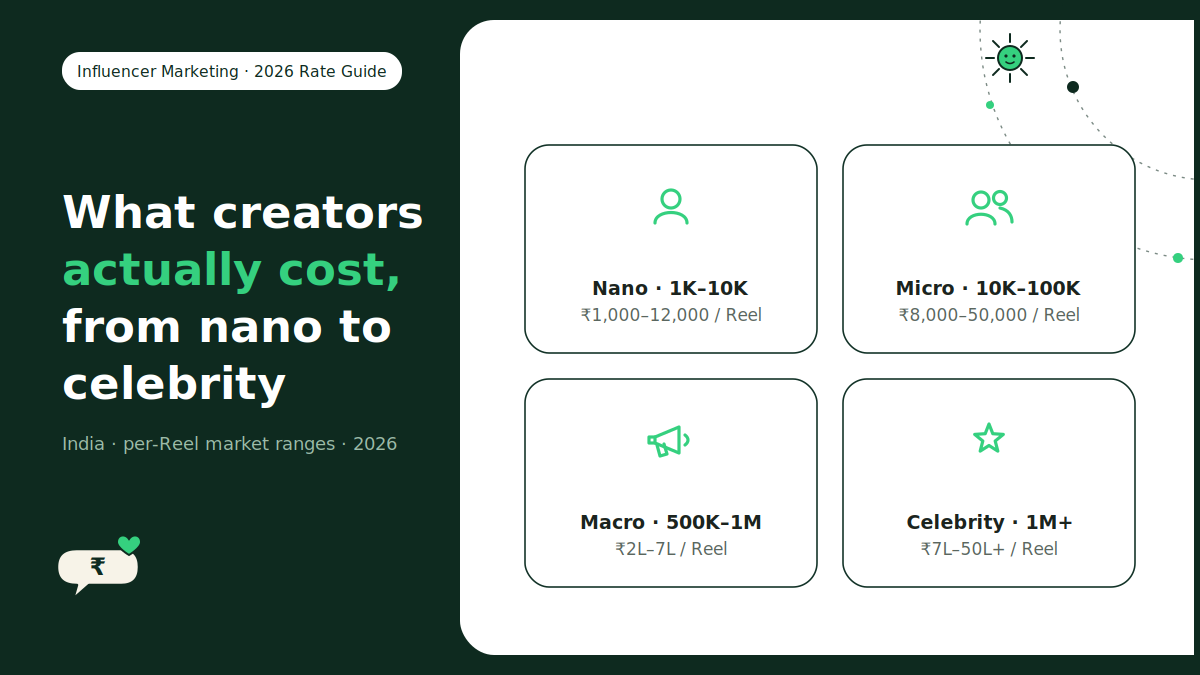
Here’s the 2026 market at a glance — per-deliverable ranges for campaigns targeting Indian audiences:
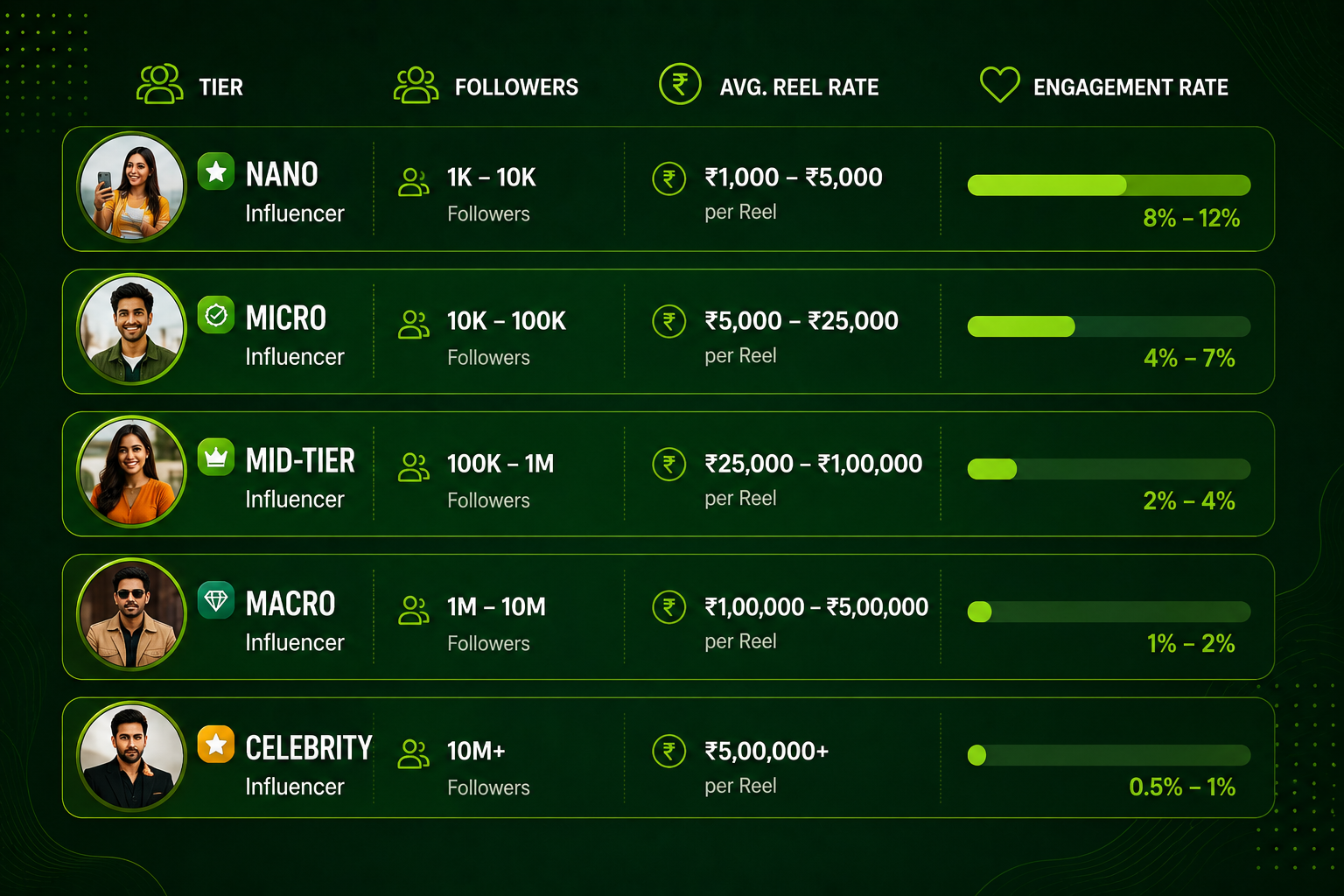
| Tier | Followers | Instagram Reel | Instagram Story | YouTube integration |
|---|---|---|---|---|
| Nano | 1K–10K | ₹1,000–12,000 | ₹400–5,000 | ₹5,000–25,000 |
| Micro | 10K–100K | ₹8,000–50,000 | ₹3,000–20,000 | ₹25,000–1,00,000 |
| Mid-tier | 100K–500K | ₹50,000–2,00,000 | ₹15,000–70,000 | ₹1,00,000–4,00,000 |
| Macro | 500K–1M | ₹2,00,000–7,00,000 | ₹60,000–2,00,000 | ₹4,00,000–15,00,000 |
| Mega / Celebrity | 1M+ | ₹7,00,000–50,00,000+ | ₹2,00,000+ | ₹15,00,000–1Cr+ |
The 5 Influencer Tiers Explained
Follower tiers aren’t just price bands — each tier is a fundamentally different product. Here’s what you’re actually buying at each level.
Nano influencers: the authenticity tier
Nano creators charge ₹1,000–12,000 per Reel, and often accept barter (free product) for gifting campaigns. What you’re buying is trust: engagement rates of 8–10% — double what macro creators achieve — because their audience is friends, neighbours, and a genuine community. Ideal for hyperlocal campaigns, UGC seeding, and marketplace review content. The catch: reach per creator is tiny, so real campaigns need 10–50 of them, and coordinating fifty individuals is its own job.
Micro influencers: the ROI sweet spot
Micro creators run ₹8,000–50,000 per Reel and deliver the best conversion economics in Indian influencer marketing: enough reach to matter, engagement still high, prices still sane. This is where most D2C brands should live. The catch: quotes in this tier vary wildly for near-identical audiences — never respond to a single quote without comparing 3–5 similar creators first.
Mid-tier: where creators become businesses
At ₹50,000–2,00,000 per Reel, mid-tier creators are semi-professional operations — consistent output, better production, media kits, and real audience data. You get meaningful reach with engagement that hasn’t yet collapsed. Expect more formal contracts, longer lead times, and the first appearance of talent managers in your inbox.
Macro: reach with production muscle
Macro creators charge ₹2–7 lakh per Reel and justify it with broadcast-quality content, creative teams, and audiences big enough to move brand-awareness metrics. The catches: engagement rates dip well below the smaller tiers, and manager commissions of 15–25% enter the deal — negotiate them into the quoted rate, never on top of it.
Mega & celebrity: licensing cultural capital
From ₹7 lakh to ₹50 lakh+ per post, you’re not buying content — you’re renting fame. This works for mass-market launches and trust-heavy categories (BFSI, autos, appliances) where a known face de-risks the purchase. But run the arithmetic first: one celebrity post can cost the same as 100+ nano and micro activations that collectively reach a more committed, better-converting audience. For most D2C brands, that trade is rarely worth it.
What Actually Determines an Influencer’s Rate
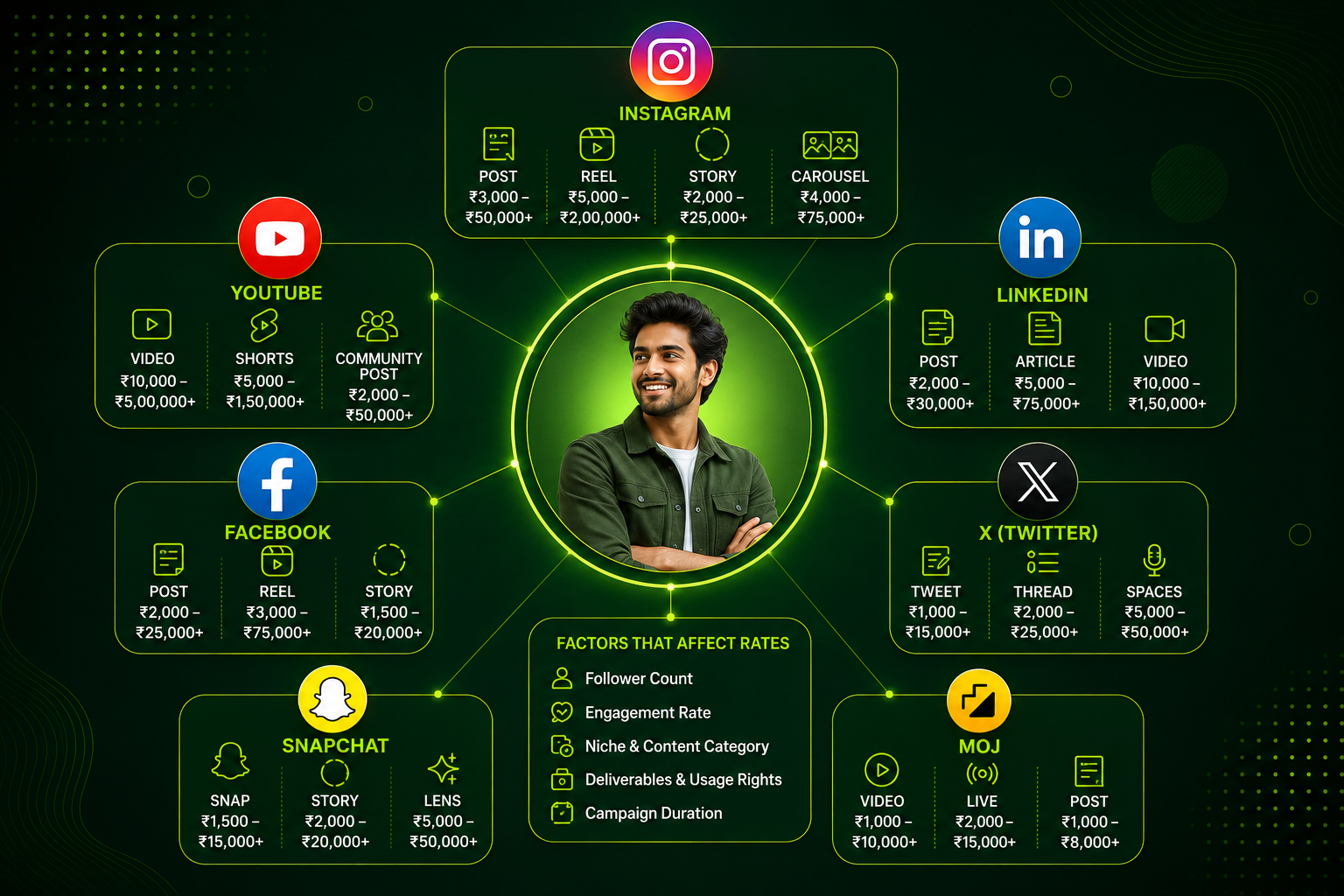
Two creators with identical follower counts can charge 3× apart — and both be priced fairly. These seven factors are what actually move the number:
Engagement rate — the real currency
A 45K-follower creator with 7% engagement is worth more than a 180K one at 1.5%. Divide average likes + comments by followers before you even ask for a quote; pay for attention, not audience size.
Niche
Finance, tech, and B2B creators command 30–50% premiums over lifestyle and food at the same follower count, because their audiences carry higher commercial value and fewer creators serve them.
Platform & format
Reels are the benchmark; Stories run 30–50% cheaper; carousels price close to Reels; YouTube is the most expensive per deliverable because production effort and content lifespan are both far higher.
Usage rights & whitelisting
The quoted rate buys a post on their profile. Running their content as your own paid ad (whitelisting), on your website, or in performance campaigns costs 30–100% extra — and is usually worth it, since creator ads outperform studio ads on Meta.
Exclusivity
Asking a creator not to work with competitors for 3–6 months means asking them to turn down income. Expect a 25–50% premium for category exclusivity — only pay it when the category is genuinely contested.
City & language
2026’s biggest shift: regional Tier-2/3 creators (Indore, Coimbatore, Guwahati) deliver 2–3× the engagement of metro macro-influencers at a fraction of the cost — because they share a language and a pin code with the customer. Vernacular creators are currently the best value in the market.
Deliverable bundles
A campaign package (e.g., 1 Reel + 2 Stories + 1 grid post) typically prices 15–25% below the sum of per-post rates — and gives the algorithm multiple touchpoints. Always negotiate bundles, never single posts.
Rates by Platform
Instagram: the benchmark
Instagram sets the reference price for the whole market — every rate in the quick rate card above is Instagram-first. Within the platform, Reels carry the premium (reach potential), Stories are the budget format (24-hour lifespan), and grid posts sit in between. Story-plus-link deals are the cheapest way to buy direct traffic from a creator.
YouTube: the premium buy
YouTube costs the most per deliverable and is often worth it: a 60–90 second integration inside a creator’s video runs roughly 2–3× their Instagram Reel rate, and a dedicated video 4–6×. What you’re buying is depth and shelf life — YouTube videos keep converting for months while a Reel dies in days. Best for high-consideration products: gadgets, finance, education, appliances.
LinkedIn & regional platforms
LinkedIn creator posts carry a B2B premium — small audiences, but every follower is a potential buyer or hirer. At the other end, vernacular platforms (Moj, ShareChat, regional YouTube) offer the cheapest CPMs in the market for Tier-2/3 reach, and pair naturally with the regional-creator trend above.
| Format (same ~50K micro creator) | Typical 2026 rate |
|---|---|
| Instagram Reel | ₹15,000–40,000 |
| Instagram Story (per frame) | ₹5,000–15,000 |
| Instagram carousel / grid post | ₹12,000–35,000 |
| YouTube integration (60–90 sec) | ₹30,000–80,000 |
| YouTube dedicated video | ₹50,000–1,20,000 |
| LinkedIn post (B2B niche) | ₹20,000–60,000 |
The Hidden Costs Nobody Quotes Upfront
The quoted rate is rarely the final bill. Budget for these before you sign anything:
The “second bill” checklist
GST (18%): registered creators add it on top of the quote — ₹20,000 becomes ₹23,600. Ask upfront whether the rate is inclusive.
Talent-manager commission (15–25%): standard at macro and celebrity tiers. Insist the commission sits inside the quoted rate, not stacked on it.
Agency & coordination overhead (30–40% of program budget): discovery, contracting, and tracking consume real money whether you pay an agency or burn internal hours on it.
Usage rights & whitelisting fees: repurposing creator content in your paid ads costs 30–100% extra (see factor 04) — budget it from the start, because you’ll want it.
Product, shipping & reshoots: barter units, courier costs, and one contractual reshoot clause if content misses brief. Small individually; real money across 30 creators.
Sample Campaign Budgets by Business Size
What realistic programs look like at each spending level — framed by outcome, not just spend:
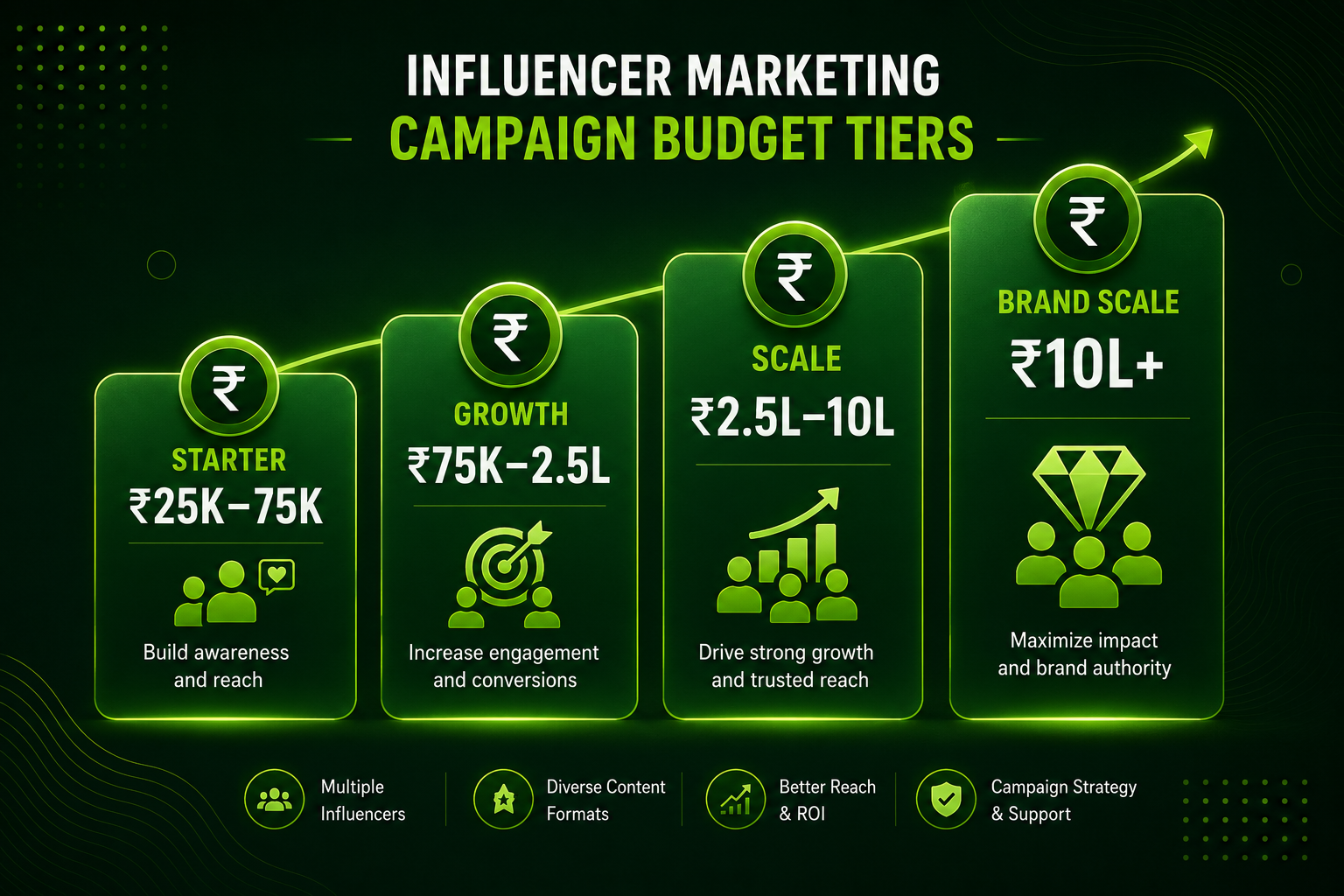
Starter: prove the channel
5–10 nano creators plus product gifting, concentrated on one city or one tight niche. The goal isn’t revenue — it’s learning which creator profiles and hooks move your product, and banking a folder of UGC. Below ₹25,000, reach is too thin to measure anything unless you’re hyper-local.
Growth: build the UGC engine
8–15 nano and micro activations monthly, with roughly 20% of budget reserved for whitelisting the winners as paid ads. This is the tier where influencer marketing stops being a campaign and becomes a content supply chain for your performance marketing.
Scale: always-on program
20–40 creators across micro and mid-tier, a dedicated coordinator (in-house or a ₹50K/month freelancer), regional-language pods for Tier-2/3 markets, and quarterly repeat contracts with proven performers — repeat collaborations convert better and price cheaper than one-offs.
Brand: anchors plus armies
One or two macro/celebrity anchor faces for mass awareness, amplified by a long tail of regional micro creators who convert that awareness locally. At this level, ambassador contracts (3–12 months) beat per-post buying on both price and authenticity.
How to Negotiate Without Insulting Creators
Good negotiation isn’t grinding a creator down — it’s removing your own information disadvantage. The process: compare 3–5 similar creators before responding to any quote (if one is 2–3× the peer average without celebrity status or rare niche expertise, negotiate or move on). Ask for the media kit plus screen-recorded insights — reach, audience geography, and story link-clicks — not screenshots, which are trivially faked. Negotiate bundles, not posts, for the 15–25% package discount. And put everything in writing, even for a ₹5,000 deal: deliverables, dates, revision count, usage rights, and payment terms (50% advance / 50% on delivery, or milestone-based).
Walk away when you see these:
- ✕Rates 2–3× the peer average with no niche or engagement justification — you’re subsidising their overconfidence.
- ✕Refusal to share live insights — every serious creator screen-records analytics on request; hesitation usually means the numbers are ugly.
- ✕Suspicious engagement — comment sections full of emoji-only replies and follower spikes without viral posts point to purchased audiences.
- ✕No GST invoice or written agreement — you lose input credit and all recourse if they ghost after the advance.
- ✕“Full payment upfront” on a first collaboration — standard market practice is split payment; insist on it.
Influencers vs Ads: Where Does This Fit in Your Budget?
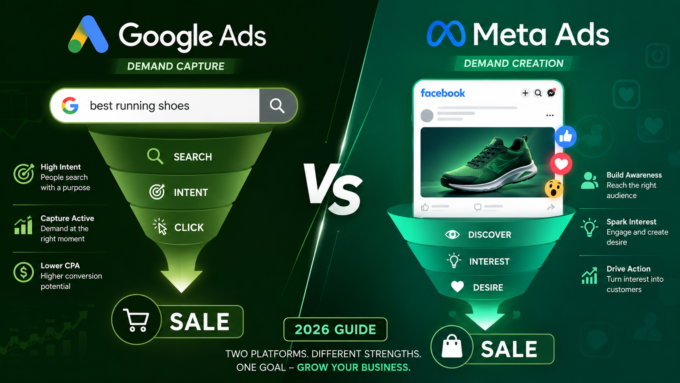
Influencer spend isn’t a rival to your ad budget — it’s the creative and trust layer that makes it work harder. Whitelisted creator content routinely becomes the best-performing ad in a Meta account, and brand searches on Google spike measurably after creator campaigns — the same full-funnel loop we mapped in our Google Ads vs Meta Ads guide. One sequencing rule: don’t fund influencers before your conversion funnel works. Creators can flood a landing page with warm traffic; they can’t fix a page that doesn’t convert. For how this slots into your wider social budget, see our social media marketing cost guide.
Frequently Asked Questions
How much do influencers charge per post in India?
What’s the minimum budget for an influencer campaign in India?
Do influencers charge GST?
Are micro influencers better than celebrities for ROI?
How do I verify an influencer’s followers are real?
What are usage rights and why do they cost extra?
The Bottom Line
Influencer rates in India are negotiable precisely because they’re opaque — and now you’ve seen behind the curtain. The tier-one takeaway: match the tier to the goal. Buying awareness? Reach matters, and macro faces earn their premium. Buying conversions? Engagement is the currency, and a squad of micro and regional creators will beat one big name almost every time. Compare peers, bundle deliverables, budget the second bill, and put every deal in writing.


![How Much Does Social Media Marketing Cost in India? [2026 Guide]](https://zieldigital.com/blog/wp-content/uploads/2026/07/how-much-does-social-media-marketing-cost-india-680x453.png)


Leave a comment