


Agencies sell “performance marketing” at a premium. Job boards list performance marketers and digital marketers as separate roles. And somewhere in between, business owners quietly wonder whether they’ve been buying the wrong thing all along.
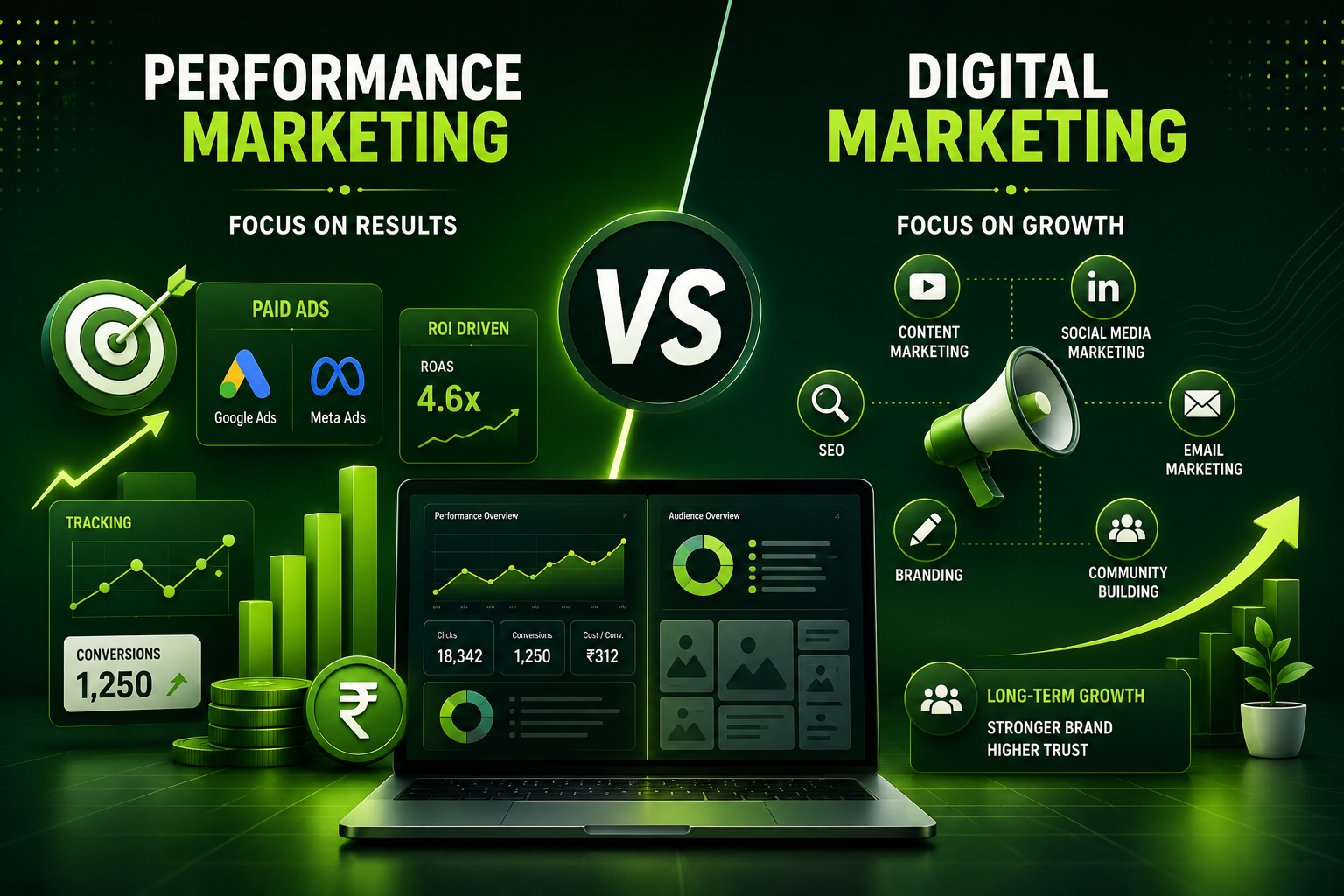
Let’s clear the fog immediately: performance marketing vs digital marketing isn’t an either/or choice, because one lives inside the other. Performance marketing is a subset of digital marketing — defined not by different channels, but by how you pay and what you measure.
In this guide: plain-English definitions of both, a side-by-side comparison, where the line genuinely blurs, five scenarios that tell you which to prioritise at your stage, and how to hold an agency accountable for either.
The Quick Answer
The 30-second verdict
Digital marketing is the umbrella term for all marketing done online: SEO, content, organic social media, email, influencer marketing, paid ads, and online PR. Its goals span the whole funnel — awareness, trust, conversion, retention.
Performance marketing is the slice of it where you pay for measurable outcomes — clicks, leads, sales — and every rupee is tracked to a result. Think Google Ads, Meta Ads, and affiliate programs run against CPL, CPA, and ROAS targets.
Comparing them is like comparing vehicles vs cars: one is the category, the other is a type within it. The real question isn’t which one — it’s what mix, at your stage.
What Is Digital Marketing?
Digital marketing is every activity that promotes your business through online channels. Under the umbrella: SEO (ranking on Google organically), content marketing (blogs, guides, video), organic social media, email marketing, influencer collaborations, paid advertising, and online PR. If it happens on a screen and builds your business, it’s digital marketing.
Its goals cover the entire customer journey — making strangers aware you exist, earning their trust, converting them, and keeping them. And crucially, many of its returns are compounding but hard to attribute: a blog post that ranks for three years, a brand name people type directly into Google, an Instagram presence that makes your ads convert better. (We’ve mapped the costs of two of these branches already — see our guides on social media marketing costs and influencer rates in India.)
This is why brand-building spend matters even when it can’t be measured per-rupee: it’s the reason customers choose you when they finally see your ad instead of a competitor’s. Unmeasurable is not the same as unvaluable.
What Is Performance Marketing?
Performance marketing is defined by its payment and measurement model, not its channels: you pay for actions — a click (CPC), a lead (CPL), a sale (CPA) — and judge everything against return on ad spend (ROAS). No action, no meaningful cost. Every campaign is an equation: spend in, revenue out, kill what doesn’t compute.
The core channels: Google Ads, Meta Ads, affiliate marketing (partners paid per sale), native advertising, and increasingly performance-based influencer deals — creators paid via affiliate codes or per conversion rather than flat fees. If you’re choosing between the two biggest channels, our Google Ads vs Meta Ads guide covers exactly that decision.
The craft behind it is less about placing ads and more about the machinery around them: conversion tracking (pixels, Conversions API), attribution, relentless creative testing, and landing-page optimisation. A performance marketer’s real job is making every next rupee more efficient than the last one.
The Side-by-Side Comparison
| Dimension | Digital Marketing | Performance Marketing |
|---|---|---|
| Scope | The full umbrella — all online marketing | A subset focused on paid, trackable actions |
| Primary goal | Awareness, trust, conversion, retention | Measurable conversions, now |
| Payment model | Mostly effort/time-based (content, SEO, social) | Pay per click, lead, or sale |
| Measurement | Directional — traffic, engagement, brand lift | Exact — every rupee tied to an outcome |
| Time horizon | Compounding over months and years | Results in days and weeks |
| Risk profile | Slow to prove, durable once built | Instant feedback, stops when spend stops |
| Typical KPIs | Rankings, reach, followers, branded search | CPL, CPA, ROAS, conversion rate |
| Best fit | Building why customers choose you | Capturing customers ready to act |
The biggest practical difference is the accountability window. Performance marketing answers “what did last month’s spend return?” with a number. Digital marketing more broadly answers “why do customers choose us at all?” — a question no single month’s dashboard can settle, but one that determines what your performance campaigns cost forever.
Where the Line Gets Blurry
Here’s the honest part most comparison articles skip: the boundary is a spectrum, not a wall. SEO is classic “digital” marketing, yet it produces trackable enquiries and revenue every month. Brand-awareness campaigns run through the same Meta Ads Manager as hardcore conversion campaigns. An influencer post is brand-building — until you attach a discount code and it becomes a measurable sales channel.
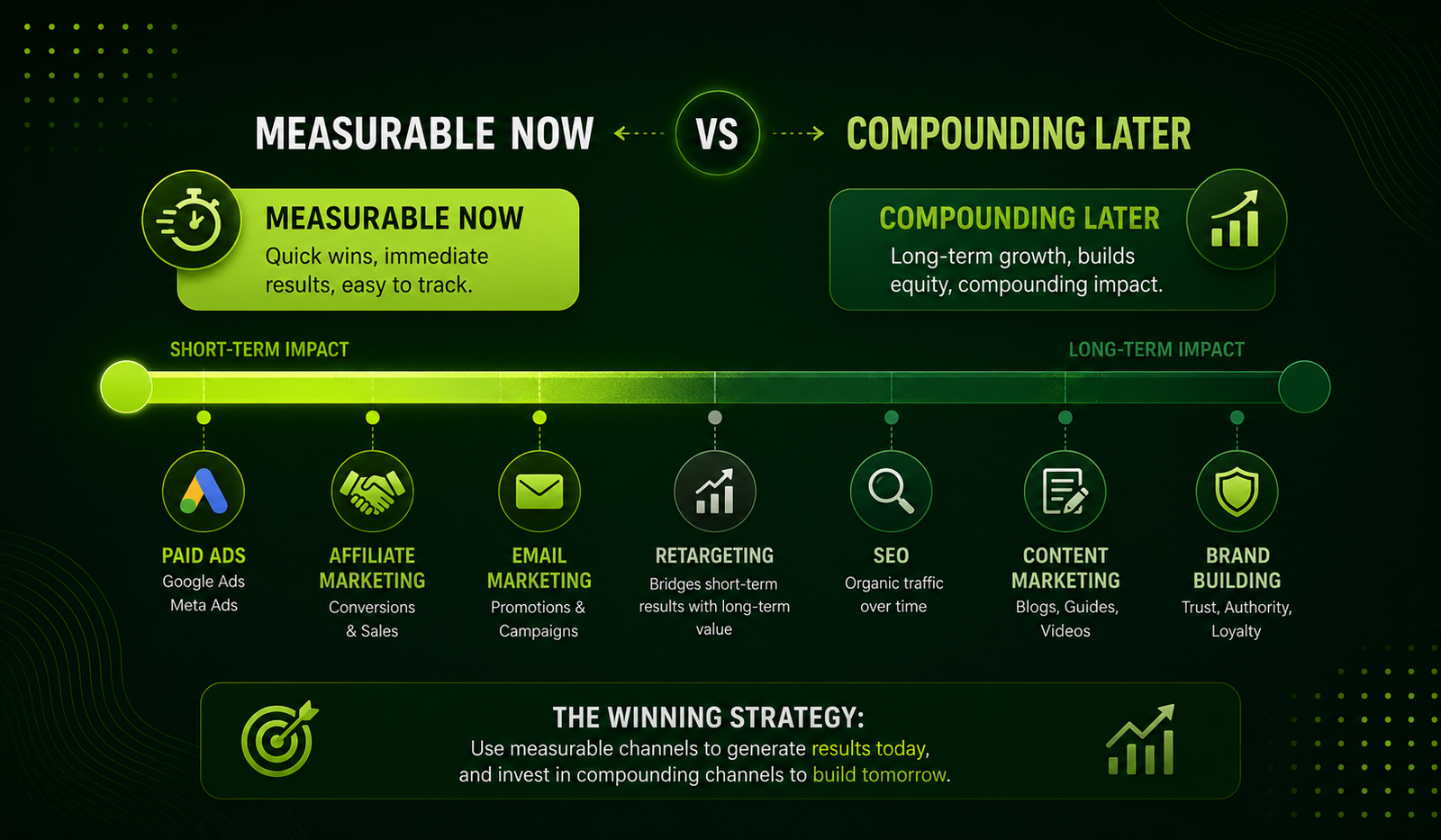
And in 2026, better attribution tooling — server-side tracking, marketing-mix modelling, AI-assisted analytics — keeps making more of the “unmeasurable” measurable. So the more useful mental model isn’t two boxes; it’s a slider between measurable-now spend and compounding-later spend. Every marketing rupee sits somewhere on that slider, and your job is choosing the right distribution for your stage.
Which Does Your Business Need?
Find your scenario — each points to a different starting mix:
New business, little or no revenue yet
Go performance-first. You need cash flow and proof that demand exists before philosophical brand spend makes sense. Google or Meta Ads (whichever matches your buyer’s intent) plus a converting landing page is the whole playbook. Rough mix: 80% performance / 20% foundational content.
Growing, but ad results are plateauing
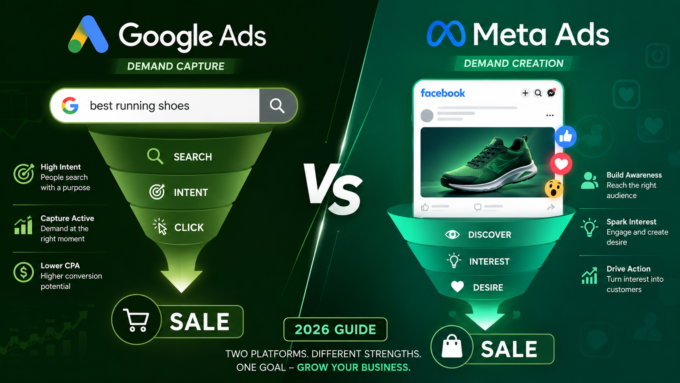
Rising CPAs with flat creative usually mean you’ve exhausted the demand that exists — the fix is demand creation: content, social presence, creators. This is the same capture-vs-create logic from our Google Ads vs Meta Ads framework, applied one level up. Shift toward 60/40.
Established brand with strong repeat business
Your moat is preference, not auctions. Weight the mix toward brand, content, community, and retention (email/WhatsApp), and use performance spend defensively — brand-search protection and remarketing. Think 40/60 performance-to-brand.
B2B or long sales cycles
Nobody impulse-buys a ₹10 lakh contract. Content and SEO build the pipeline of educated prospects; performance ads capture and retarget them when they enter buying mode. The two aren’t sequential here — they run in parallel from day one, roughly 50/50.
Seasonal or event-driven business
Concentrate performance bursts in your demand windows (festive season, admissions, wedding months) and keep a light always-on brand presence so you’re not re-introducing yourself from zero every season. Performance-heavy in season, brand-light off season.
Why the Best Strategies Use Both
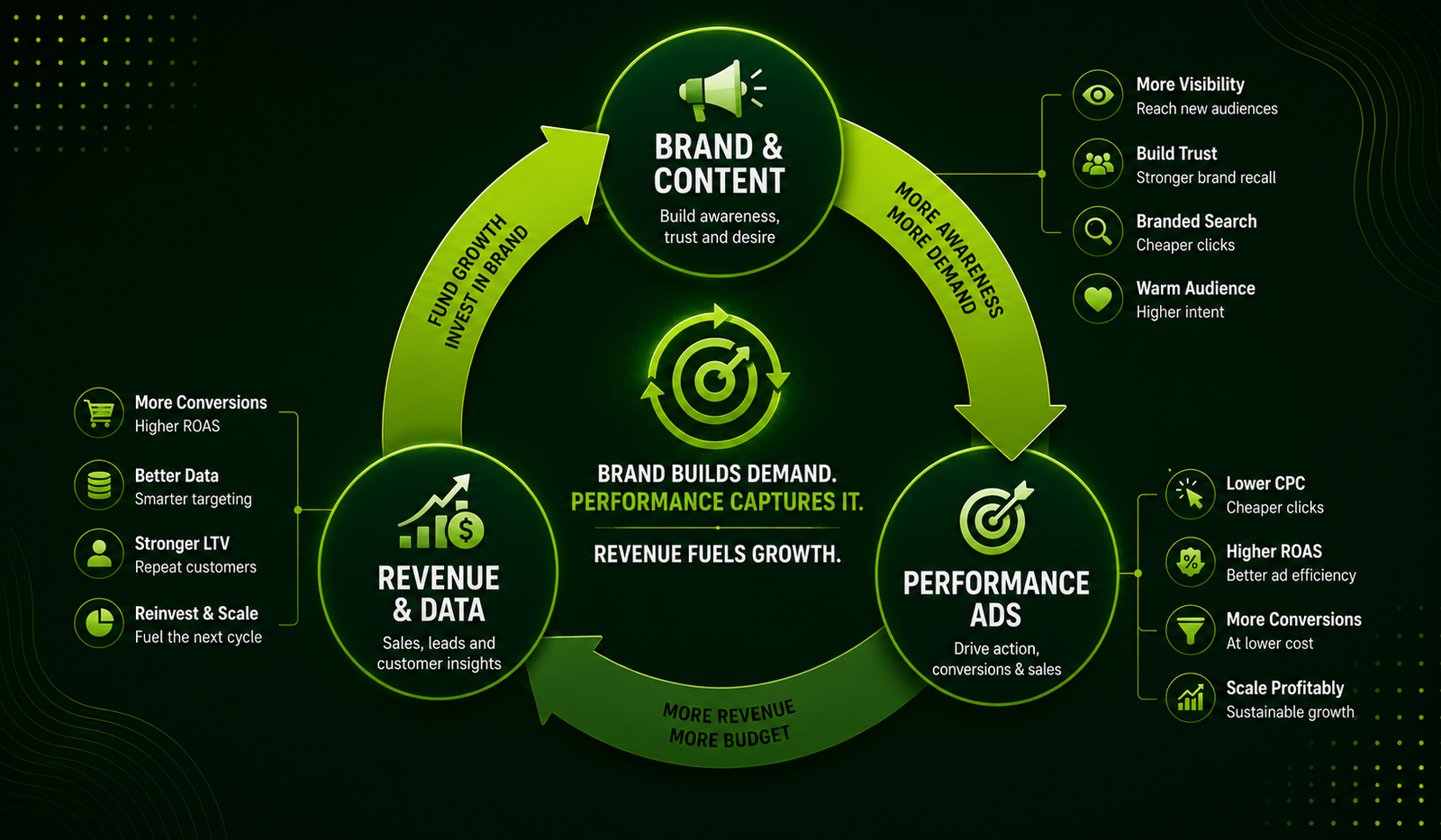
The two halves feed each other in a flywheel. Brand and content work makes performance marketing cheaper: recognised names earn higher click-through rates, better Quality Scores, lower CPCs, and a growing stream of branded searches that convert at a fraction of cold-traffic cost. Meanwhile, performance marketing funds and validates the brand bets — revenue pays for content, and campaign data tells you which messages, audiences, and offers deserve long-term investment.
It’s the same full-funnel loop we mapped between Meta and Google, playing out at strategy level. The one-line rule: performance without brand gets more expensive every year; brand without performance is untracked hope.
How to Hold an Agency Accountable for Either
Because the two are measured differently, they demand different reporting. For performance retainers, insist on: CPL/CPA/ROAS against targets agreed in writing, full platform access in your own ad accounts, and spend transparency down to the campaign. For broader digital retainers, track directional compounding: organic traffic and rankings growth, engagement quality, email list growth, and — the most underrated brand metric — growth in branded search volume.
Walk away when you see these:
- ✕ROAS promises on brand work — anyone guaranteeing a return on content or awareness spend in month one is selling you fiction.
- ✕Impression-only reporting on performance retainers — if you’re paying for outcomes, reach numbers are noise dressed as results.
- ✕Ad accounts owned by the agency — your data, pixels, and history should live in accounts you control, or leaving them means starting from zero.
Frequently Asked Questions
Is performance marketing part of digital marketing?
Is SEO performance marketing?
Which is better for small businesses?
What does a performance marketer actually do?
Can I measure ROI on brand-focused digital marketing?
The Bottom Line
Performance marketing and digital marketing aren’t rivals — one is the category, the other is its most measurable slice. Every business needs both eventually; what changes is the mix. Early on, let performance spend prove demand and fund the machine. As you grow, shift rupees toward the compounding end — content, SEO, brand — so that every future performance campaign starts cheaper than the last. The strategic question was never “which one.” It’s “what distribution, at your stage.”
![How Much Does Social Media Marketing Cost in India? [2026 Guide]](https://zieldigital.com/blog/wp-content/uploads/2026/07/how-much-does-social-media-marketing-cost-india-680x453.png)


Leave a comment