

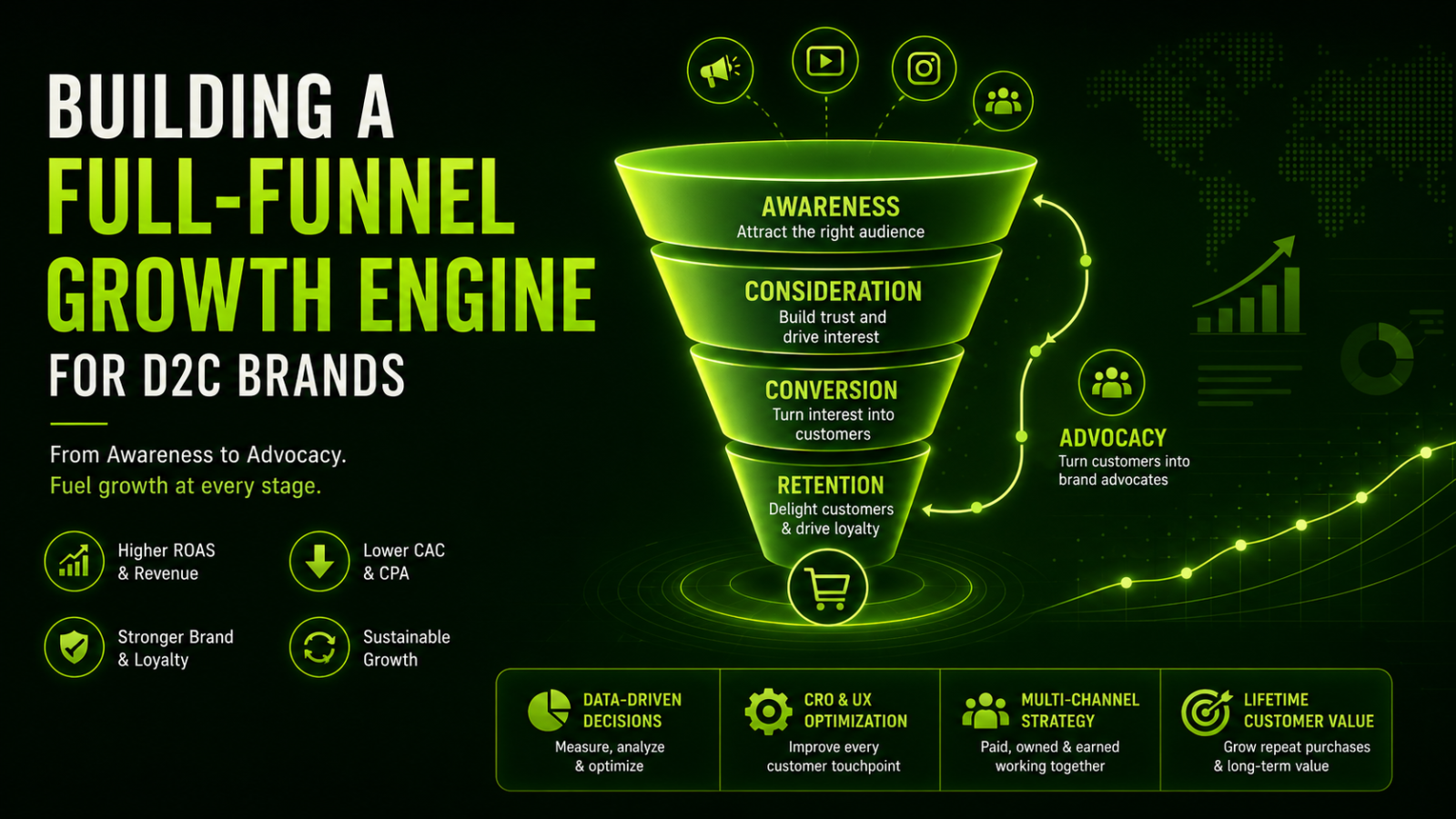

Here’s the pattern every D2C founder eventually lives through. You pour money into Meta, and at ₹50,000/month the ROAS looks fantastic. So you scale to ₹5 lakh — and watch your CAC balloon while ROAS quietly craters.
The ads didn’t get worse. You simply ran out of demand to harvest. What you have isn’t a full-funnel growth engine; it’s a demand-harvesting machine, and the well has run dry. The fix isn’t a better creative or a lower bid — it’s a system where every stage feeds the next: awareness that creates new demand, consideration that earns trust, conversion that captures intent efficiently, and retention that funds the whole thing and refills the top.
This guide lays out that four-stage engine — the channels and content for each layer, the metrics that actually matter, and, most importantly, how the stages compound so the machine gets cheaper every turn instead of more expensive.
Why “just run more ads” stops working
Performance marketing captures existing demand — and existing demand is finite. At any moment only a fixed slice of your market is actively in-market, ready to buy. When you scale spend against that fixed pool, you’re not reaching more buyers; you’re bidding against yourself for the same ones. CAC rises, ROAS falls, and the whole thing feels like a creative problem when it’s actually a structural ceiling.
This is the exact distinction between demand capture and demand creation we unpacked in Google Ads vs Meta Ads, and the difference between renting results and building a system we covered in Performance vs Digital Marketing. Harvesting alone always hits a wall.
The escape is to build demand at the top and loyalty at the bottom, so the harvestable pool keeps refilling instead of draining. New people discover you, existing customers come back, and both keep the conversion layer fed with warm, cheaper-to-close buyers.
A growth engine isn’t a funnel you push people through once — it’s a loop that gets cheaper every turn.
The four stages of a D2C growth engine
Picture the engine not as a funnel with a bottom, but as a loop. Awareness → Consideration → Conversion → Retention — and then retention curves back to awareness, because happy customers refer friends and post content that becomes your next cycle’s top-of-funnel. That feedback arrow is the whole point; it’s what separates an engine from a one-way chute.
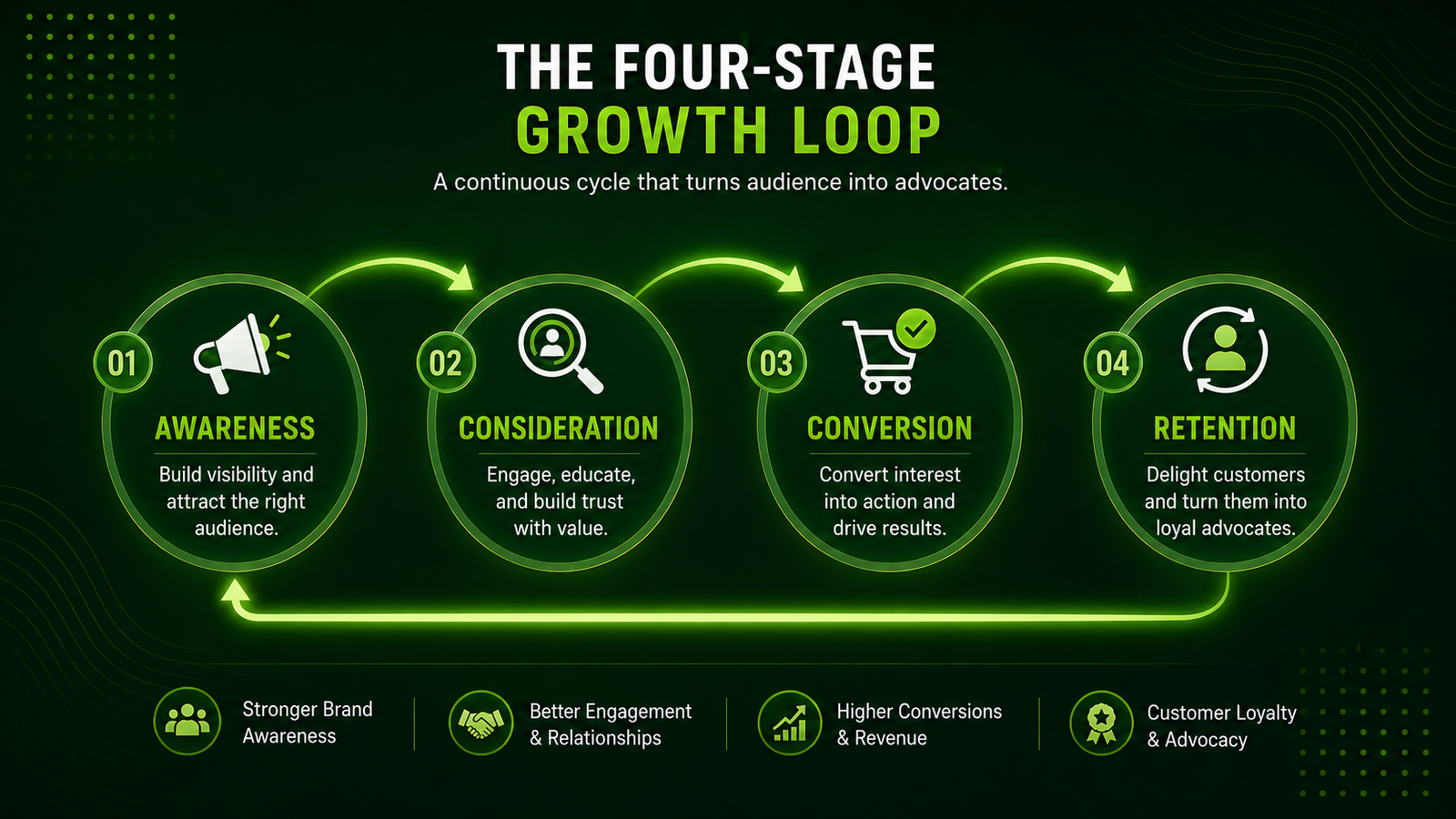
The guiding principle: each stage has its own goal, its own channels, its own content, and its own success metric. The single most common mistake in D2C is using conversion tactics — discount ads, “buy now” creative, retargeting offers — at every stage. You cannot discount your way to awareness. Match the tactic to the layer, and each stage starts doing the job the next one depends on.
Stage 1 — Awareness: creating demand
This is demand creation — the top-of-funnel work that refills the pool your conversion campaigns draw from. Skip it and you’re forever fishing in the same shrinking pond.
Channels: Meta and Instagram Reels for cheap reach, influencer seeding (see our breakdown of influencer marketing rates in India), YouTube for depth, and top-of-funnel content and SEO for evergreen discovery. Content: entertaining, educational, scroll-stopping — never “buy now.” If it feels like an ad, it’s in the wrong stage.
The India angle: in 2026, regional creators and vernacular content are the cheapest awareness available. A Tamil, Marathi, or Bengali creator with a tight local following often delivers a fraction of the CPM of English metro content, with far higher trust.
The metric — and the key correction: measure by reach, video views, CPM, and new-audience penetration, not ROAS. Judging awareness spend by last-click sales is the number-one reason brands kill the exact campaigns feeding their conversions.
Budget signal · 40–50% of spendStage 2 — Consideration: earning trust
Awareness got attention; consideration converts that attention into a relationship you can nurture toward a purchase.
Channels: retargeting on Meta and Google, email and WhatsApp capture-and-nurture, reviews and UGC, comparison and educational content, and organic social. Content: social proof, product education, the founder story, and honest objection-handling — the material that answers “why should I trust you?” before you ever ask for the sale.
The India angle: WhatsApp is the consideration workhorse. Broadcast lists, product catalogs, and gentle cart nudges happen in the channel Indian buyers actually check — open and response rates leave email in the dust. A WhatsApp opt-in is often worth more than a follow.
The metric: engagement rate, email and WhatsApp opt-ins, return visits, add-to-cart rate. The common mistake: no capture mechanism at all — running awareness that floods your site with interested strangers who then vanish uncollected. Capture is the plug in the bucket.
Budget signal · 15–20% of spendStage 3 — Conversion: capturing demand
This is where performance marketing genuinely belongs — and where most brands wrongly spend everything.
Channels: Google Search for brand and high-intent non-brand terms, Meta retargeting and Advantage+ Shopping, Google Shopping and Performance Max, and cart-recovery flows. Content: sharp product pages, clear offers, honest urgency, and a frictionless checkout with the trust badges Indian buyers look for — COD availability and a visible returns policy do more here than any headline.
The key insight: this layer works far better because Stages 1 and 2 did their jobs. A visitor who discovered you through a creator, then got nurtured on WhatsApp, converts at a dramatically lower CAC than a cold click. Conversion doesn’t create efficiency — it inherits it.
The metric: conversion rate, CAC, ROAS, cart-abandonment recovery rate. The common mistake: pointing conversion campaigns at cold traffic and blaming the creative when CAC is brutal. Cold traffic belongs in Stage 1.
Budget signal · 25–30% of spendStage 4 — Retention: the profit engine
Here’s the uncomfortable truth of D2C economics: the first purchase often only breaks even after CAC. The profit lives in the second, third, and tenth orders — which means retention isn’t a nice-to-have, it’s where the business actually makes money.
Channels: email and WhatsApp lifecycle flows, loyalty programs, subscriptions, post-purchase UGC prompts, and community. Content: replenishment reminders timed to your product’s cycle, smart cross-sells, VIP tiers, and review requests that turn buyers into proof.
The loop close: this is where the engine becomes self-feeding. A delighted customer refers a friend and posts a reel about your product — and that referral and that UGC are Stage 1 awareness, produced for free by people who already paid you. Retention doesn’t just protect revenue; it manufactures your cheapest top-of-funnel.
The metrics: repeat purchase rate, LTV, LTV:CAC, churn, referral rate. The common mistake: treating the sale as the finish line. If your relationship ends at the “thank you” page, you’re rebuying every customer forever.
Budget signal · 10–15% of spend · highest ROIThe metrics that tie it together
The single biggest mindset shift is moving off last-click ROAS and onto system-level metrics. No individual campaign’s ROAS tells you whether the engine is healthy. The numbers that do: blended CAC (total spend ÷ total new customers), MER (total revenue ÷ total spend), LTV:CAC (aim for 3:1 or better), payback period, and contribution margin.
| Funnel stage | Primary metric | What “good” looks like (India) |
|---|---|---|
| Awareness | CPM / reach / views | Low CPM, growing new-audience %; views over sales |
| Consideration | Opt-in & add-to-cart | Steady email/WhatsApp capture; rising return visits |
| Conversion | CAC / ROAS / CVR | ROAS 2.5–4× on warm traffic; falling CAC over time |
| Retention | Repeat rate / LTV:CAC | LTV:CAC 3:1+; 25–40% repeat purchase rate |
| System | Blended CAC / MER | MER trending up as the funnel matures |
Attribution honesty: no attribution model is perfect. Platform dashboards double-count and flatter themselves — Meta and Google will both claim the same sale. Trust blended metrics over platform numbers. Same caveat we flagged in Google Ads vs Meta Ads: when in doubt, believe your bank account, not the ad manager.
How the stages compound
This is the payoff. A single-stage brand adds spend and gets linear — then declining — returns. A full-funnel brand gets compounding ones, because each stage lowers the cost of the others:
- Awareness lowers conversion CAC — warm audiences close cheaper than cold, so a full top-of-funnel makes bottom-of-funnel spend go further.
- Retention funds more awareness — higher LTV gives headroom to outbid competitors on acquisition and still profit.
- UGC from retention becomes awareness creative — your best top-funnel ads are often customer content you didn’t pay to produce.
- Branded search becomes your cheapest conversion channel — and it only exists because awareness built the brand people now search for.
That’s the flywheel from Performance vs Digital Marketing, made concrete for D2C. The one-line takeaway: brands that build all four stages can afford a higher CAC than single-stage competitors — and that ability to profitably outspend on acquisition is the entire structural advantage.
Common ways the engine breaks
- All budget in conversion — no top-of-funnel means a fixed pool and steadily rising CAC.
- Awareness with no capture — the leaky bucket; interested traffic arrives and vanishes uncollected.
- No retention — you’re renting revenue, rebuying every customer, never owning an audience.
- Judging every stage by ROAS — kills the awareness that feeds the conversions you’re measuring.
- Scaling spend before the funnel is built — pouring water faster into a bucket full of holes.
- No post-purchase flows — the highest-ROI work, left undone.
- Ignoring WhatsApp and email — renting audiences on platforms instead of owning channels you control.
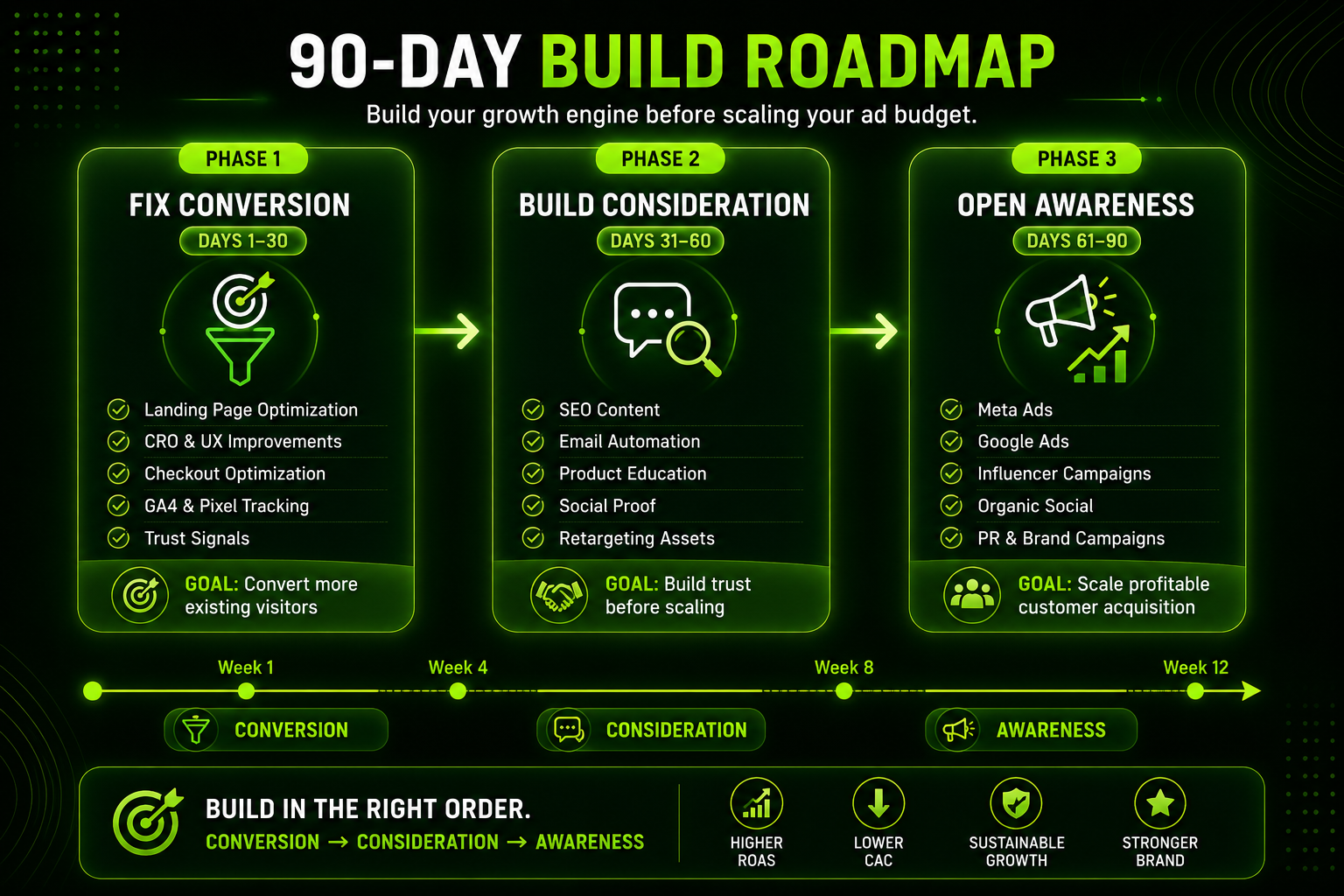
A sample 90-day build sequence
Build order matters. The instinct is to start with awareness — but pouring traffic into a funnel that can’t catch or convert just wastes it. Build the bucket before you turn on the tap.
Fix conversion
Stop the leaks first. Sharpen product pages, install conversion tracking, set up cart-recovery flows, and claim branded search. When demand arrives, capture the sale.
Build consideration
Add capture and nurture: email and WhatsApp opt-ins, retargeting audiences, and a reviews/UGC engine. Interested visitors now get held and warmed.
Open awareness
Only now turn on the taps — creators, Reels, top-funnel content. With conversion tight and consideration catching everything, awareness spend compounds.
Frequently asked questions
What is a full-funnel growth engine?
It’s a marketing system with four connected stages — awareness, consideration, conversion, and retention — where each stage feeds the next and retention loops back into awareness via referrals and UGC. Unlike a linear funnel you push people through once, an engine gets cheaper and more efficient every cycle because upper stages lower the cost of lower ones.
How much should a D2C brand budget for each funnel stage?
A rough starting split for a scaling brand: 40–50% awareness, 15–20% consideration, 25–30% conversion, and 10–15% retention. These shift with maturity — early brands weight conversion more heavily while they build the upper funnel.
Why is my ROAS dropping as I scale?
Because you’re harvesting a finite pool of in-market buyers. As you scale spend against fixed demand, you bid against yourself, CAC rises, and ROAS falls. It’s a structural ceiling, not a creative problem — the fix is building awareness to refill the pool and retention to raise LTV.
Is retention really more important than acquisition?
They work together, but retention is where D2C brands actually profit — the first purchase often only breaks even after CAC. Retention also produces referrals and UGC that become your cheapest awareness, so it funds acquisition rather than competing with it.
How long before a full-funnel strategy shows results?
Conversion fixes can lift performance within weeks. The compounding benefits — lower blended CAC, branded search, repeat revenue — build over 3–6 months as awareness and retention mature. The engine is a system that strengthens over time, not an overnight switch.
Do small D2C brands need all four stages?
Yes — but sequenced, not simultaneous. Small brands should build conversion and consideration first, add lightweight retention flows, then scale awareness once the bucket holds water. Every stage matters; the order and intensity scale with budget.
Single-stage brands hit a ceiling. Full-funnel brands compound. The entire point of the engine is that it gets cheaper and stronger with every cycle — which means competitors relying on ads alone eventually can’t afford to compete with you on acquisition, because your LTV lets you outbid them and still profit.
Find out which stage of your engine is broken
ZielDigital’s full-funnel growth audit maps your current engine, pinpoints the broken or missing stages, and hands you a stage-by-stage build plan — no guesswork, no “just run more ads.”
Get your free growth audit

Leave a comment