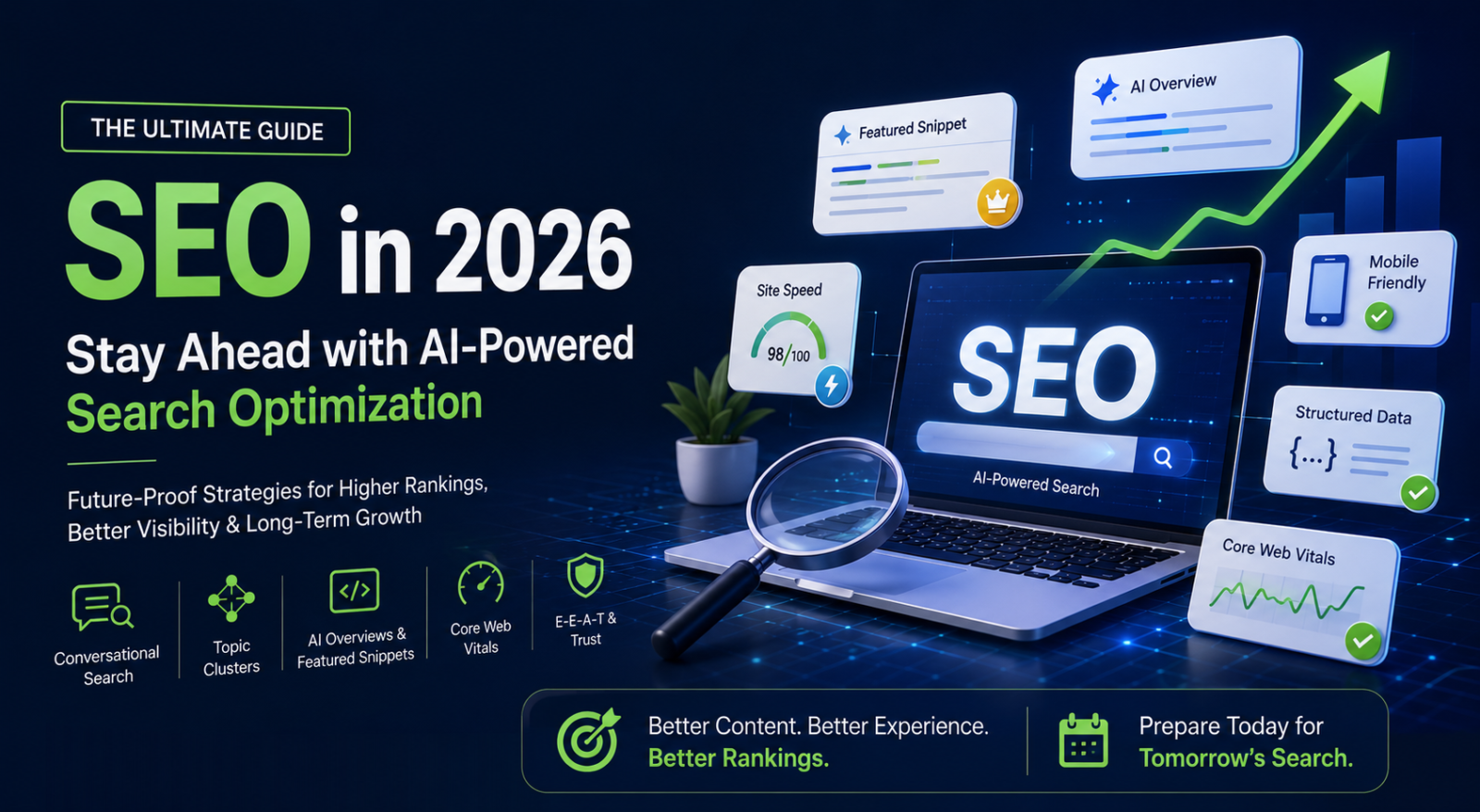
Introduction: SEO Isn’t Dead—It’s Evolving in the Era of AI-Powered Search
SEO in 2026 is no longer just about ranking for keywords. With the rise of AI-powered search, search engines now use artificial intelligence to understand user intent, evaluate content quality, and deliver personalized search experiences. Google AI Overviews, ChatGPT, Gemini, and other AI-driven platforms are transforming how users discover information. Businesses must create content that genuinely answers user questions, demonstrates expertise, and delivers real value. Simply adding keywords is no longer enough to achieve sustainable rankings.
Modern SEO combines high-quality content, technical optimization, fast website performance, structured data, and an excellent user experience. Google’s AI systems now prioritize websites that demonstrate expertise, trust, and relevance. Businesses that focus on solving user problems, improving website performance, and publishing consistent, valuable content will build stronger organic visibility and stay competitive as search algorithms continue to evolve in the era of AI-Powered Search.
Understanding the AI Search Revolution
What Has Changed?
Search engines now understand the meaning behind user queries instead of matching keywords alone. AI evaluates context, intent, and content quality to deliver more relevant search results. Websites that provide helpful and trustworthy information are more likely to achieve higher rankings and perform well in AI-Powered Search experiences.
why Traditional SEO Alone Is No Longer Enough?
Keyword optimization and backlinks still matter, but they are no longer enough on their own. Search engines also measure user engagement, page experience, content relevance, and authority. Businesses that focus on solving user problems and creating valuable content will achieve better long-term SEO results.
How AI Is Changing Search Rankings
AI-Powered Search and User Intent
AI now focuses on understanding why users search instead of simply what they type. Content that directly answers user questions and provides valuable information performs better. User-focused content helps improve visibility, organic traffic, and success in AI-Powered Search results.
Machine Learning-Enabled Ranking Systems
Machine learning constantly analyzes relevance, freshness, authority, and user behavior. Websites should regularly update content and maintain a fast, user-friendly experience. This helps improve rankings as search algorithms continue learning and adapting to changing user behavior.
Creating Content That AI and Humans Trust
Focus on Helpful Content
Helpful content remains the foundation of modern SEO. Articles should answer real questions, solve problems, and provide practical information. Easy-to-read and informative content keeps users engaged while improving search performance across traditional search and AI-Powered Search platforms.

Experience, Expertise, Authority, and Trust (E-E-A-T)

E-E-A-T stands for Experience, Expertise, Authoritativeness, and Trustworthiness. It is a content quality framework used by Google to evaluate whether a website provides reliable, accurate, and valuable information to users. While E-E-A-T is not a direct ranking factor, it significantly influences how Google assesses the quality and credibility of content, especially for topics related to health, finance, education, and legal advice.
1. Experience
Experience refers to the first-hand knowledge or practical experience of the content creator. Google values content written by individuals who have personally used a product, provided a service, or experienced a situation. For example, a digital marketer sharing real SEO campaign results or a doctor writing about patient care demonstrates genuine experience.
2. Expertise
Expertise measures the knowledge and skills of the content creator in a specific field. Content created by qualified professionals or industry experts is considered more reliable. Websites should provide accurate, well-researched, and up-to-date information to demonstrate expertise.
3. Authoritativeness
Authoritativeness reflects the reputation and recognition of a website or author within an industry. Businesses can build authority by publishing high-quality content, earning backlinks from reputable websites, receiving positive reviews, and being mentioned by trusted sources.
4. Trustworthiness
Trust is the most important element of E-E-A-T. A trustworthy website provides accurate information, uses HTTPS security, clearly displays contact details, includes privacy policies, and regularly updates its content. Trust helps users feel confident in the information provided and encourages Google to rank the website higher.
Importance of E-E-A-T in SEO
Strong E-E-A-T signals improve website credibility, increase user trust, and enhance long-term search visibility. By demonstrating real experience, expert knowledge, industry authority, and trustworthy information, businesses can improve their chances of ranking higher in Google Search, AI-powered search engines, and Google AI Overviews.
Conclusion:
E-E-A-T is a key principle of modern SEO that helps Google identify high-quality and reliable content. Websites that consistently provide valuable, accurate, and experience-based information are more likely to earn better rankings, increased organic traffic, and long-term online authority.
Original Research and First-Hand Experience
Original research and first-hand experience play an important role in modern SEO because they provide unique, authentic, and valuable information that cannot be easily copied by competitors or generated by AI. Google prefers content that demonstrates real-world knowledge and practical expertise, making it more likely to rank higher in search results.
1. What is Original Research?
Original research refers to content created using your own data, surveys, experiments, case studies, or industry reports. Instead of repeating information from other websites, businesses collect and publish unique insights that provide additional value to readers.
2. What is First-Hand Experience?
First-hand experience means sharing practical knowledge gained from personally using a product, providing a service, or solving a real business problem. For example, an SEO agency explaining how it increased organic traffic by 60% using a real client case study demonstrates first-hand experience.
3. Benefits of Original Content
Publishing original research and personal experiences helps build credibility and trust. It encourages other websites to reference your content, resulting in natural backlinks that improve domain authority and search rankings.
Technical SEO for the AI Era
Technical SEO is the process of optimizing a website’s technical elements so that search engines can efficiently crawl, index, and understand its content. In the age of AI-powered search, technical SEO is more important than ever because it helps search engines deliver accurate and relevant results while providing users with a better browsing experience.
Technical SEO includes improving website speed, mobile responsiveness, structured data, internal linking, crawlability, security, and overall site performance. A technically optimized website is easier for both search engines and AI systems to analyze, increasing its chances of ranking higher in search results and AI-generated responses.
The three key components of Technical SEO for the AI Era are Core Web Vitals, Structured Data, and Crawlability.
Core Web Vitals and User Experience
Core Web Vitals are Google’s performance metrics used to measure the overall user experience of a website. They evaluate how quickly a page loads, how responsive it is to user interactions, and how visually stable the content remains during loading.
The three Core Web Vitals are:
1. Largest Contentful Paint (LCP)
Measures how quickly the main content of a webpage loads. Google recommends an LCP score of less than 2.5 seconds for a good user experience.
2. Interaction to Next Paint (INP)
Measures how quickly a website responds when users click, tap, or interact with a page. A lower INP indicates a smoother browsing experience.
3. Cumulative Layout Shift (CLS)
Measures the visual stability of a webpage. Pages should avoid unexpected layout shifts while loading to provide a better user experience.
Importance of Core Web Vitals
Fast-loading pages, mobile responsiveness, and smooth navigation improve user satisfaction, reduce bounce rates, increase engagement, and help search engines rank websites more effectively. Optimizing Core Web Vitals also supports better visibility in AI-powered search.
Structured Data and Schema Markup
Structured Data is a standardized format used to help search engines understand the content of a webpage more effectively. Schema Markup is the code added to a website that provides additional information about content, such as articles, products, reviews, FAQs, events, and businesses.
Benefits of Structured Data
1. Better Search Understanding
Schema markup provides additional information about your webpage in a structured format that search engines can easily interpret. It helps Google understand the purpose, category, and context of your content, resulting in more accurate indexing and improved relevance for search queries.
2. Rich Results
Structured data increases the chances of your webpage appearing as rich results in Google Search. These enhanced listings may include star ratings, FAQs, product prices, recipes, event details, or business information, making your search result more visually appealing and informative.
3. Featured Snippets and AI Overviews
Proper implementation of schema markup helps search engines identify important information on your page, increasing the likelihood of being featured in Google’s Featured Snippets and AI Overviews. This improves your website’s visibility and establishes it as a trusted source of information.
4. Higher Click-Through Rate (CTR)
Rich search results attract more attention than standard search listings because they display additional information such as ratings, images, and FAQs. These enhanced results encourage more users to click on your website, leading to increased organic traffic and better overall SEO performance.
Structured Data and Schema Markup
Structured Data is a standardized format used to help search engines understand the content of a webpage more effectively. Schema Markup is the code added to a website that provides additional information about content, such as articles, products, reviews, FAQs, events, businesses, and local organizations. It helps search engines interpret webpage information accurately and display it in more useful ways to users.
Benefits of Structured Data
1. Better Search Understanding
Schema markup helps search engines clearly identify the purpose and context of webpage content. Instead of simply reading text, search engines can understand whether the page is about a product, service, blog, event, or FAQ. This improves content indexing and increases the chances of serving the page for relevant search queries.
2. Rich Results
Structured data increases the chances of displaying rich snippets, such as star ratings, FAQs, product information, recipes, event details, and business information in search results. Rich results make your website stand out from standard listings and provide users with more information before they click. This improves visibility and enhances the overall search experience.
3. Featured Snippets and AI Overviews
Proper schema implementation improves the possibility of appearing in Featured Snippets, Google AI Overviews, and other AI-powered search experiences. Search engines can quickly extract important information from structured content and present it directly to users. This increases your website’s authority and improves brand visibility in AI-generated search results.
4. Higher Click-Through Rate (CTR)
Rich search results are more attractive to users because they display additional details like ratings, images, FAQs, prices, or business information. These enhanced listings capture more attention than regular search results, encouraging users to click on your website. A higher CTR can also improve your website’s overall organic search performance over time.
Optimizing for AI-Powered Search Experiences
AI-powered search engines such as Google AI Overviews, ChatGPT, Gemini, Claude, and Perplexity are changing how users find information online. Instead of displaying only a list of website links, these platforms generate answers by analyzing multiple trusted sources. To remain competitive, businesses must optimize their content not only for traditional search engines but also for AI-powered search experiences.
Unlike conventional SEO, AI-powered search focuses on understanding context, user intent, content quality, and authority. Websites that provide structured, accurate, and helpful information are more likely to be referenced by AI systems and appear in AI-generated search results.
Write for Conversational Search
Users today search differently than they did a few years ago. Instead of typing short keywords like “SEO tips”, they now ask complete questions such as “How can I improve my website ranking in AI-powered search?” This shift has been driven by voice search, AI assistants, and conversational search engines.
Writing conversational content means creating articles that answer questions naturally, just as a human expert would. Use simple language, clear explanations, and direct answers that match the user’s search intent. Including FAQs, question-based headings, and concise answers makes your content easier for AI systems to understand and present in search results.
Build Topic Clusters Instead of Individual Keywords
Traditional SEO often focused on creating separate pages for individual keywords. Modern SEO uses topic clusters, where one comprehensive pillar page is supported by several related articles covering subtopics in depth.
For example, a pillar page on “SEO in 2026” could link to articles about Technical SEO, AI Overviews, E-E-A-T, Schema Markup, Core Web Vitals, and Keyword Research. This interconnected structure helps search engines understand the relationship between topics and establishes your website as an authority.
Topic clusters also strengthen internal linking, improve crawlability, and encourage visitors to explore multiple pages, increasing session duration and reducing bounce rates.
Optimize for Featured Snippets and AI Overviews
Featured Snippets and Google AI Overviews are among the most visible positions in modern search results. These sections provide users with immediate answers, often without requiring them to visit multiple websites.
To optimize your content, use descriptive headings, short paragraphs, bullet points, numbered lists, tables, and direct answers to common questions. Structure your content logically so AI systems can easily identify key information.
Including FAQ sections, definitions, and concise summaries also increases the likelihood of your content being selected for AI-generated responses.
Benefits
- Increases visibility at the top of search results.
- Improves brand authority and trust.
- Generates more qualified organic traffic.
- Enhances opportunities to be cited by AI-powered search engines.
Future-Proofing Your SEO Strategy
Search engine algorithms continue to evolve rapidly with advancements in artificial intelligence. Businesses should focus on long-term SEO strategies that prioritize quality, user experience, and continuous improvement rather than relying on outdated ranking techniques.
Future-proofing your SEO strategy means creating sustainable content, adapting to AI-driven search trends, and regularly updating your website to meet changing user expectations.
Avoid AI Content Spam
Artificial Intelligence has become a valuable tool for content creation, but it should support human creativity rather than replace it. Publishing large amounts of generic AI-generated content without review can reduce content quality and damage user trust. Always edit AI-generated content by adding personal experience, industry insights, case studies, statistics, and practical examples. Human-reviewed content demonstrates expertise and aligns more closely with Google’s E-E-A-T guidelines.
Measure the Right SEO Metrics
Many businesses focus only on keyword rankings, but modern SEO success requires tracking a wider range of performance indicators. Rankings alone do not show whether your website is generating valuable business results.
Monitor metrics such as organic traffic, user engagement, average session duration, bounce rate, conversion rate, click-through rate (CTR), and leads generated through organic search. These insights help identify successful content, improve user experience, and refine future SEO strategies.
Regular performance analysis allows businesses to adapt quickly to algorithm updates and changing user behavior.
Important SEO Metrics
- Organic Traffic
- Click-Through Rate (CTR)
- Conversion Rate
- Average Engagement Time
- Bounce Rate
- Indexed Pages
- Keyword Visibility
- AI Overview Visibility
- Backlinks and Domain Authority
SEO Checklist for 2026

A successful SEO strategy requires consistent optimization across content, technical performance, and user experience. Businesses should regularly audit their websites to ensure they meet current search engine standards.
An effective SEO checklist includes creating helpful content, optimizing Core Web Vitals, implementing structured data, improving mobile responsiveness, strengthening internal linking, and updating older content. It is equally important to focus on E-E-A-T, search intent, website security, and accessibility.
Regular monitoring and continuous optimization help maintain strong rankings and improve long-term organic growth.
2026 SEO Checklist
- Publish people-first, helpful content.
- Optimize for AI-powered search and Google AI Overviews.
- Improve Core Web Vitals.
- Implement structured data (Schema Markup).
- Build strong internal linking.
- Create topic clusters.
- Demonstrate E-E-A-T.
- Update old content regularly.
- Optimize for voice and conversational search.
- Monitor SEO performance and user behavior.
Conclusion
SEO in 2026 is no longer about simply ranking for keywords—it is about creating exceptional user experiences and becoming a trusted source of information for both people and AI systems. As AI-powered search engines become more sophisticated, businesses must focus on producing high-quality content that answers real user questions, demonstrates expertise, and delivers measurable value.
Long-term SEO success depends on combining helpful content, technical excellence, structured data, E-E-A-T, and AI-ready optimization. Businesses that embrace conversational search, build topical authority through content clusters, optimize for Featured Snippets and Google AI Overviews, and continuously improve their websites will be better positioned for sustainable growth.
Rather than chasing algorithm updates, successful organizations should focus on solving user problems, building trust, and creating authoritative content. This user-first approach will not only improve traditional search rankings but also increase visibility across AI-powered search platforms, ensuring lasting organic success in the evolving digital landscape.
Leave a comment