

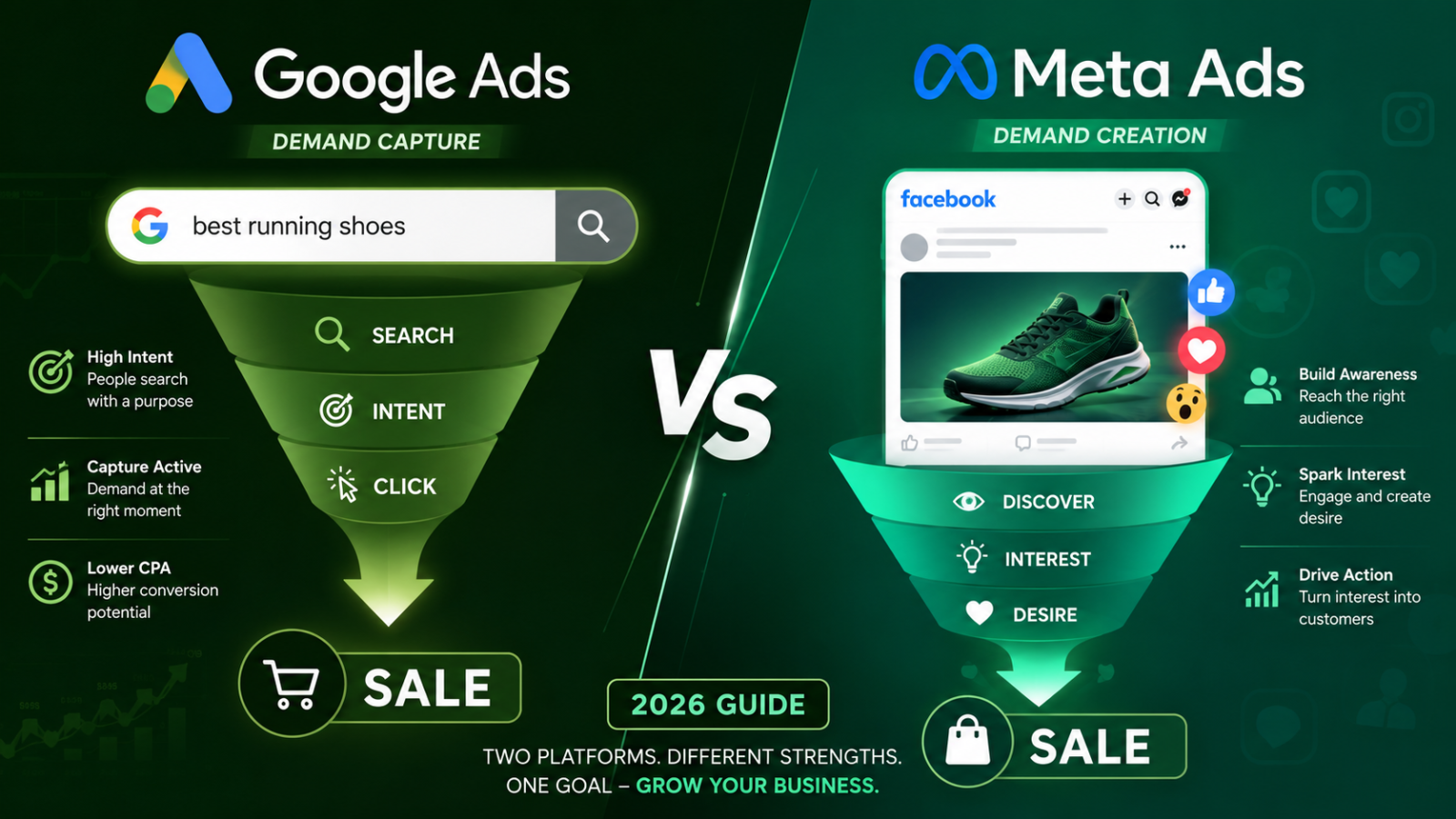

Two advertising giants. One budget. And a decision that quietly determines whether your next six months of ad spend compounds into growth or evaporates into impressions nobody remembers.
The Google Ads vs Meta Ads question is the most common one we hear from Indian businesses starting paid marketing — and the most commonly answered wrong, because people compare the platforms on cost when they should be comparing them on intent. The short version of everything below: Google captures demand that already exists; Meta creates demand that doesn’t exist yet. Which one you fund first depends entirely on where your customer’s intent lives today.
In this guide you’ll get the fundamental difference explained properly, real 2026 cost benchmarks in rupees, a 5-question decision framework, and sample budget splits by business type — so you can allocate with confidence instead of guessing.
Google Ads vs Meta Ads: The Quick Answer
The 30-second verdict
Choose Google Ads first if people already search for what you sell — services, urgent needs, “near me” queries, B2B solutions, high-consideration purchases. You’re buying customers at the moment of intent.
Choose Meta Ads first if your product needs to be discovered — new D2C brands, visual products, impulse purchases, categories nobody types into Google yet. You’re creating desire in the feed.
Mature businesses run both, because the platforms feed each other. But if you’re choosing where the first rupee goes: match the platform to where your customer’s intent lives.
The Fundamental Difference: Demand Capture vs Demand Creation
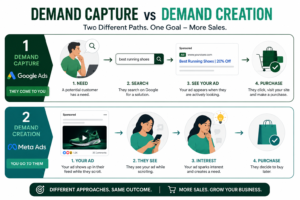
Every tactical difference between the two platforms flows from one strategic difference: who initiates the interaction.
How Google Ads works: capturing demand
On Google, the customer moves first. They type “AC repair Chennai” or “best CRM for small business” and your ad appears as an answer. You’re bidding in an auction for demand that already exists — which is why Google traffic converts fast, and why competitive keywords get expensive. The ceiling is search volume: you can’t capture demand nobody has.
How Meta Ads works: creating demand
On Meta, you move first. Your ad interrupts someone scrolling Instagram Reels or Facebook who wasn’t looking for you at all. Targeting is built on who they are — demographics, interests, behaviour, lookalikes of your buyers — not what they searched. Done well, Meta manufactures desire for products people didn’t know existed. The catch: intent is lower, so your creative and funnel do the heavy lifting.
| Dimension | Google Ads | Meta Ads |
|---|---|---|
| Intent level | High — user is actively searching | Low to medium — user is discovering |
| Targeting basis | Keywords & search intent | Demographics, interests, lookalikes |
| Ad formats | Search text, Shopping, Display, YouTube | Feed, Reels, Stories, carousels, WhatsApp |
| Funnel stage | Bottom — ready to act | Top & middle — awareness, desire |
| Buyer mindset | “I need this now” | “Oh, that’s interesting” |
| Creative dependency | Moderate — copy & landing page | Very high — creative is the targeting |
The Case for Google Ads
Nothing in digital marketing beats the purchase intent of a search. Someone typing “emergency plumber near me” or “GST filing software price” is minutes — not months — from a decision, and Google Ads puts you in front of them at exactly that moment.
That’s why Google dominates for local services (repair, legal, medical, home services), B2B and high-ticket offers where buyers research before buying, and anything urgent. The ROI is measurable and bottom-funnel: keyword → click → enquiry → sale, with clean attribution most of the way. And your Search budget comes with bonus reach — Shopping ads for e-commerce, YouTube for video, Performance Max spanning all of it from one campaign.
Best for: local service businesses, legal / medical / repair, B2B SaaS, education and coaching, real estate — anything people actively search for.
The Case for Meta Ads
Meta’s superpower is reach at a price Google can’t touch. Indian CPMs on Facebook and Instagram are among the lowest in the world, which means a modest budget can put your brand in front of lakhs of precisely-matched people. And no ad format on the internet sells a visual product better than a Reel or carousel — you can demonstrate, storytell, and build a brand aesthetic in ways a text ad never will.
The targeting engine is the other half of the pitch: interest stacks, behavioural signals, and lookalike audiences that find people who resemble your best existing customers. Add retargeting — showing ads to people who visited your site or watched your video — and Meta becomes a conversion machine for the middle and bottom of your funnel too. For impulse and discovery purchases under ₹3,000, Meta frequently drives the entire journey from first scroll to checkout.
Best for: D2C and e-commerce brands, fashion, food, beauty, fitness, events, apps — and any new product category nobody is searching for yet.
Cost Comparison: CPC, CPM & CPL in India (2026)
Global benchmark articles quoting “$2 average CPC” are useless for Indian planning — our auction economics are completely different. Here’s what campaigns targeting India actually cost in 2026. Treat these as planning ranges, not quotes: your Quality Score, city tier, and creative determine where in the range you land.
Google Ads costs in India
Search CPCs in India average roughly ₹8–25 across industries, but the spread by vertical is enormous — from single-digit clicks in e-commerce to ₹100+ in insurance and finance, where a single customer’s lifetime value justifies aggressive bidding. Display clicks run far cheaper (₹2–8) but carry far lower intent, and YouTube CPVs typically sit at ₹0.50–2.50.
Meta Ads costs in India
Meta’s entry price is dramatically lower: Facebook CPMs of ₹50–400 and CPCs of ₹2–25, with Instagram slightly higher on clicks (₹6–55) and Reels placements running 25–40% cheaper than feed. Lead-gen campaigns typically land at ₹150–400 per lead for most industries. One India-specific warning: costs spike sharply — often 2–3× — during Diwali and the big sale events, so plan your testing in off-peak weeks.
| Industry | Google Search CPC | Meta CPC | Typical CPL (either platform) |
|---|---|---|---|
| Real estate | ₹40–120 | ₹8–25 | ₹400–1,500 |
| Education / coaching | ₹15–45 | ₹5–15 | ₹150–600 |
| E-commerce / D2C | ₹5–15 (Shopping) | ₹2–12 | ₹80–400 (per purchase varies) |
| B2B / SaaS | ₹30–90 | ₹15–45 | ₹500–2,000 |
| Local services | ₹10–40 | ₹4–15 | ₹150–500 |
| Healthcare | ₹15–50 | ₹6–20 | ₹300–800 |
Targeting Capabilities Compared
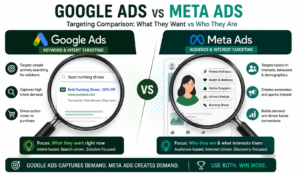
Google targets what people want right now: keywords, search intent, and increasingly AI-inferred intent signals through Performance Max. Meta targets who people are: age, city, interests, behaviours, and — most powerfully — lookalikes modelled on your actual customer list.
Each wins a different battle. Google wins “ready to buy this minute”: nothing on Meta matches the precision of someone typing exactly what you sell. Meta wins “looks exactly like your best customer”: if you have 500 past buyers, Meta can find the next 50,000 people who resemble them before they’ve ever searched for you.
The privacy era has reshaped both. Signal loss from iOS changes and cookie deprecation pushed both platforms toward AI-driven, broad-targeting systems — Google’s Performance Max and Meta’s Advantage+ — where your job shifts from micro-managing audiences to feeding the machine strong creative and clean first-party conversion data. In 2026, the advertisers winning on either platform are the ones with the best conversion tracking, not the cleverest audience hacks.
The Decision Framework: 5 Questions to Ask
Answer honestly. Option A points to Google, option B points to Meta. (If you’ve read our SEO vs PPC guide, this will feel familiar — it’s the same intent-first logic applied to paid channels.)
Do people already search for what you sell?
Run your core terms through Google Keyword Planner. A: Meaningful monthly search volume exists → there’s demand to capture. B: Little or no volume → you’ll have to create demand, and Meta is the tool for that.
Is your purchase needed, or discovered?
A: Urgent or necessary (repairs, legal help, software to fix a problem) → buyers search. B: Wanted once seen (fashion, gadgets, snacks, décor) → buyers scroll, and desire is manufactured in the feed.
Is your product visual — and can you feed the creative machine?
A: Hard to demo visually, or you can’t produce fresh creative every 1–2 weeks → Meta will underperform for you. B: Photogenic product plus consistent Reels/UGC output → Meta becomes your unfair advantage.
What’s your ticket size and sales cycle?
A: High-ticket, long consideration (B2B, real estate, education) → high-intent Google leads justify high CPCs. B: Low-ticket, instant decision (under ~₹3,000) → cheap Meta reach and impulse buying win the maths.
What’s your monthly budget?
Below roughly ₹40,000/month, don’t split. A thin budget spread across two platforms gives both algorithms too little data to optimise, and you get two mediocre campaigns instead of one strong one. Pick the platform your answers above point to, win there, then expand.
Scoring: mostly A’s → Google Ads first. Mostly B’s → Meta Ads first. A genuine mix → start with the platform matching questions 1–2 (intent beats everything), and add the second platform once the first is profitable.
Sample Budget Splits by Business Type
Once you’re ready to run both, allocation should follow each platform’s funnel role — not a lazy 50/50.
Local service business
Plumbers, clinics, tutors, salons: demand is search-driven and urgent, so Google Search (plus Local Services-style campaigns) takes the lion’s share. The Meta 20% runs remarketing and neighbourhood awareness so you’re the name they recognise when they do search.
D2C / e-commerce brand
Meta drives discovery, creative testing, and scale; Google’s 30% goes to Shopping/Performance Max and — critically — brand search, so competitors can’t intercept the demand your Reels just created.
B2B / high-ticket services
Google Search captures in-market buyers researching solutions; Meta’s 40% nurtures long sales cycles with retargeting, case-study content, and lookalikes of closed customers. (LinkedIn joins this mix at bigger budgets.)
Why the Best Accounts Run Both
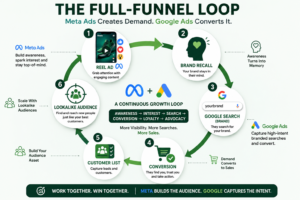
The platforms aren’t competitors in a mature account — they’re a loop. Meta creates awareness → the prospect Googles your brand a few days later → your (cheap) brand search ad converts them. Kill the Meta campaign and brand searches quietly dry up; kill the Google campaign and Meta’s demand leaks to competitors ranking on your name.
The loop runs the other way too: retarget your Google Search visitors on Instagram at a fraction of the original click cost, and mine your Meta ad comments and search terms for new Google keyword ideas.
One honest caveat: cross-platform attribution will lie to you. Google’s last-click reporting takes credit for conversions Meta initiated. Judge the system by blended metrics — total revenue against total ad spend (MER) — not by each platform’s self-graded dashboard.
Common Mistakes That Waste Ad Budget
Whichever platform you choose, these six errors burn more Indian ad budgets than bad targeting ever will:
- ✕Judging Meta by last-click ROAS — you’ll conclude it “doesn’t work” while it’s quietly filling your funnel.
- ✕Sending Google clicks to your homepage — every keyword deserves a matching landing page; homepages convert at a third of the rate.
- ✕Launching without conversion tracking — no pixel, no Conversions API, no offline import means both algorithms optimise blind.
- ✕Splitting a small budget across both platforms — two starved algorithms perform worse than one well-fed one.
- ✕Running the same Meta creative for a month — fatigue sets in within 7–14 days in 2026; stale creative pays a rising CPM penalty.
- ✕Broad match with no negative keywords on Google — the fastest way to pay premium CPCs for irrelevant clicks.
Frequently Asked Questions
Which is cheaper — Google Ads or Meta Ads?
Can I run both platforms with a small budget?
Which platform gives faster results?
Is Meta Ads good for B2B?
What minimum budget do I need for each platform in India?
Stop asking which platform is “better.” Capture demand where it already exists; create it where it doesn’t. If your customers are searching, Google Ads deserves your first rupee. If they need to discover you, Meta does. And once one platform is profitably converting, the smartest move is almost always adding the other — because together they close the loop that neither can close alone.
Budgeting for the organic side too? See our companion guides on SEO vs PPC and social media marketing costs in India.
![How Much Does Social Media Marketing Cost in India? [2026 Guide]](https://zieldigital.com/blog/wp-content/uploads/2026/07/how-much-does-social-media-marketing-cost-india-150x150.png)
![How Much Does Social Media Marketing Cost in India? [2026 Guide]](https://zieldigital.com/blog/wp-content/uploads/2026/07/how-much-does-social-media-marketing-cost-india-680x453.png)


Leave a comment