


Table of Contents
How to Generate Leads Without Increasing Your Ad Budget
Better results don’t always require a bigger budget. Sometimes, they simply require a smarter strategy. If you’re wondering how to generate leads without increasing your advertising budget, the answer often lies in optimizing your existing campaigns rather than spending more.
Many marketers assume that lowering Cost Per Lead (CPL) means increasing ad spend or finding cheaper clicks. In reality, that’s not always the case. One of the biggest improvements you can make is getting more value from the budget you already have by refining your lead generation strategy, improving audience targeting, and optimizing conversion paths.
In this article, we’ll walk through a simple strategy that helped reduce CPL by 38% without increasing ad spend. While the numbers shared here are illustrative examples (unless you replace them with your own campaign data), the approach is based on proven digital marketing best practices that businesses of all sizes can apply to generate more leads and improve campaign performance.
Whether you manage Google Ads, Meta Ads, or any other paid advertising platform, these practical insights will show you how to generate leads more efficiently, reduce your Cost Per Lead, and maximize your return on investment without spending more on advertising.
The Challenge of How to Generate Leads with a Fixed Budget
Imagine you’re running lead generation campaigns with a fixed monthly budget. Your ads are getting clicks, but the cost of acquiring each lead keeps climbing.
That was the situation we wanted to solve.
For this example, let’s assume the campaign had:
- Monthly ad budget: ₹5,00,000
- Average Cost Per Lead (CPL): ₹800
- Main platforms: Google Search and Remarketing
- Goal: Generate more qualified leads without increasing the budget
The business couldn’t simply spend more on advertising. The focus had to shift toward making every click count.
Instead of asking, “How can we spend more?” we asked, “How can we make the current budget work harder?”
That question changed the entire approach.
How to Generate Leads with Smarter Optimization Strategies
Strategy 1: Improve Audience Targeting to Generate Better Leads
The first step was to look at who the ads were reaching.
Many campaigns waste budget because they target audiences that are too broad. While broad targeting may increase traffic, it doesn’t always attract people who are ready to take action.
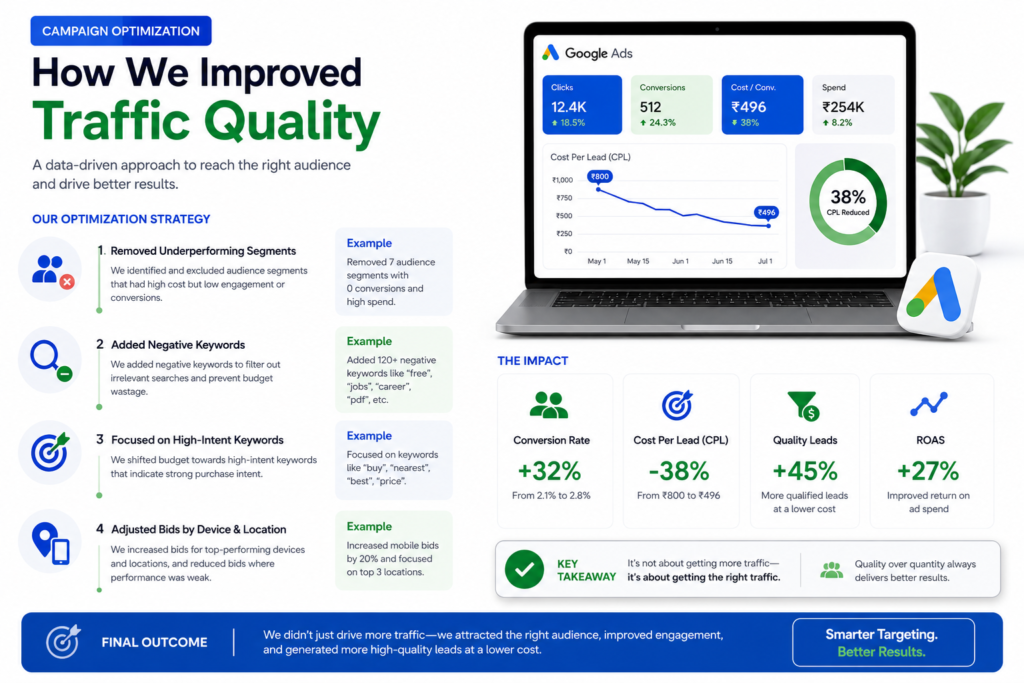
Optimize Audience Quality
To improve targeting, we:
- Removed audience segments that consistently performed poorly.
- Added negative keywords to avoid irrelevant searches.
- Focused more on high-intent keywords.
- Adjusted bids based on device and location performance.
- These changes didn’t reduce traffic dramatically—but they improved traffic quality.
The result was that a larger percentage of visitors were actually interested in the product or service.
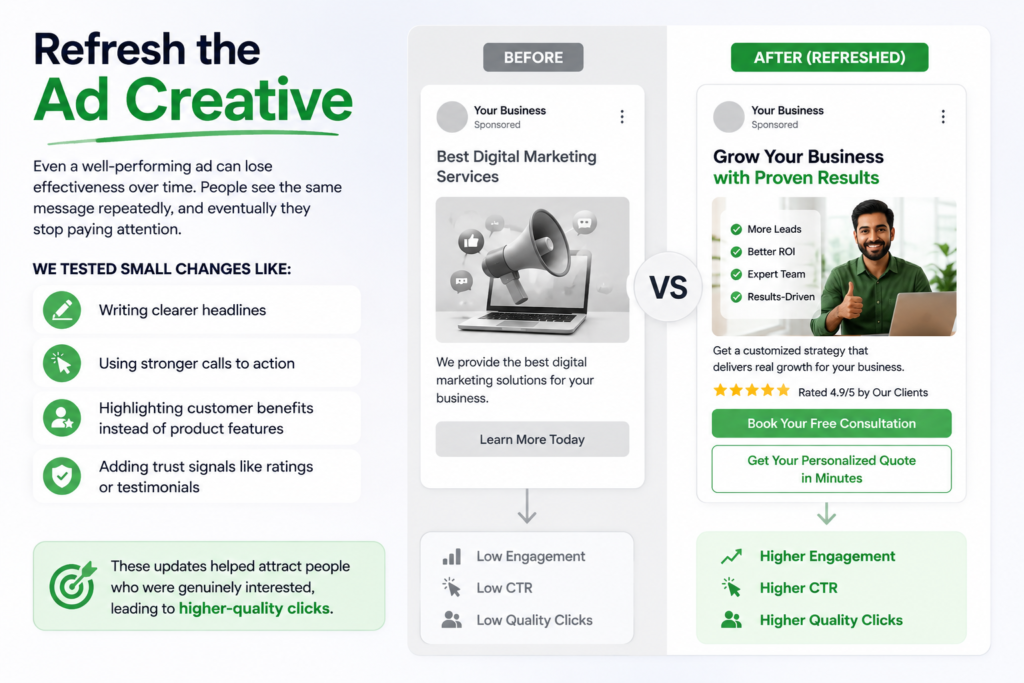
Strategy 2: Refresh Your Ad Creative to Generate More Leads
Even a well-performing ad can lose effectiveness over timse.
People see the same message repeatedly, and eventually they stop paying attention.
Create High-Converting Ad Messaging
Instead of creating completely new campaigns, we tested small changes such as:
- Writing clearer headlines.
- Using stronger calls to action.
- Highlighting customer benefits instead of product features.
- Adding trust signals like ratings or testimonials where possible.
For example, instead of saying:
“Learn More Today“
we tested messages like:
“Book Your Free Consultation“
or
“Get Your Personalized Quote in Minutes.”
These updates helped attract people who were genuinely interested, leading to higher-quality clicks.
Improving ad creatives is only one part of the equation. Businesses that understand how to generate leads consistently also focus on matching their messaging with user intent. When your ads answer the exact problems your audience is searching for, click quality improves and conversion rates naturally increase..
Strategy 3: Optimize Landing Pages to Generate More Leads
Getting someone to click on an ad is only half the job.
If the landing page is slow, confusing, or asks for too much information, many visitors will leave before becoming a lead.
Improve the Landing Page Experience
We focused on improving the overall user experience by:
- Reducing page load time.
- Simplifying the lead form.
- Making the main call-to-action easier to find.
- Removing unnecessary distractions.
- Adding customer reviews and trust badges.
- Small improvements often make a surprisingly large difference.
A high-converting landing page plays a major role in how to generate leads successfully. Even small improvements like reducing form fields, improving page speed, and displaying customer testimonials can significantly increase the number of qualified leads generated from the same advertising budget.
Strategy 4: Allocate Budget to High-Performing Lead Generation Campaigns
One important lesson in digital marketing is that every campaign doesn’t deserve the same budget.
Instead of increasing overall spending, we shifted more of the existing budget toward the campaigns that were already performing well.
Optimize Budget Allocation
Each week we reviewed:
- Cost Per Lead
- Conversion rate
- Click-through rate
- Search terms
- Audience performance
Campaigns with consistently poor performance received less budget, while stronger campaigns received more.
The total monthly spend stayed exactly the same—but it was invested more effectively.
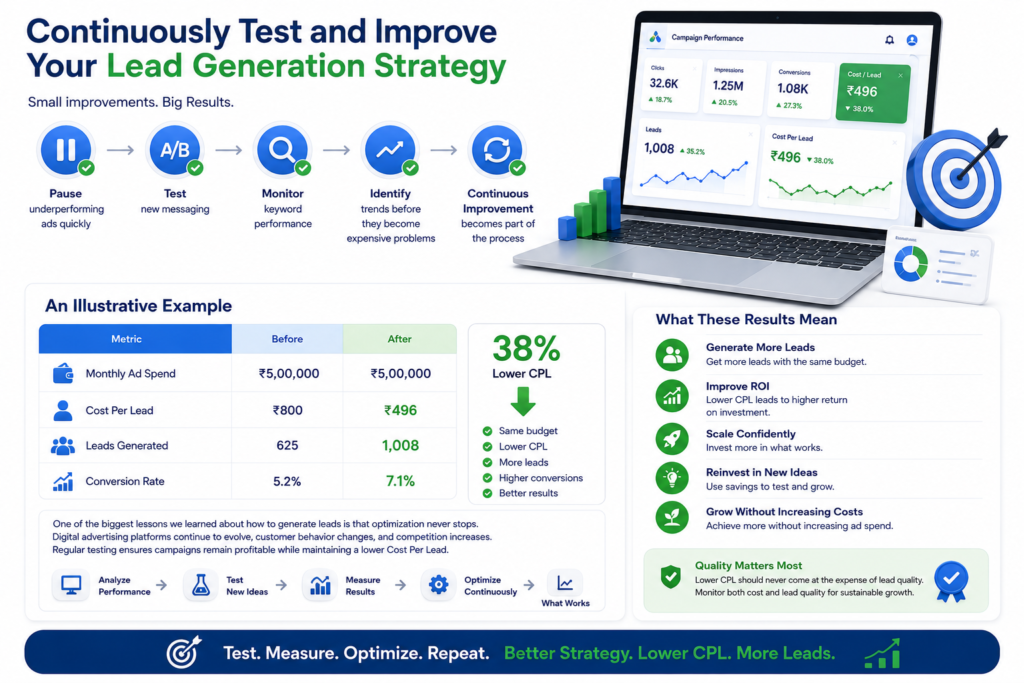
Strategy 5: Continuously Test and Improve Your Lead Generation Strategy
Successful campaigns aren’t built through one big change.
They’re built through many small improvements over time.
Measure, Test, and Optimize
Rather than making major updates every few months, we reviewed campaign performance every week.
That allowed us to:
- Pause underperforming ads quickly.
- Test new messaging.
- Monitor keyword performance.
- Identify trends before they became expensive problems.
- Continuous improvement became part of the process instead of a one-time project.
An Illustrative Example
The numbers below are representative examples to show how these strategies can influence campaign performance. Replace them with your own data if you’re creating a real case study.
Metric
- Before
- After
Monthly Ad Spend
- ₹5,00,000
- ₹5,00,000
Cost Per Lead
- ₹800
- ₹496
Leads Generated
- 625
- 1,008
Conversion Rate
- 5.2%
- 7.1%
In this example:
- The advertising budget stayed the same.
- The average CPL dropped by 38%.
- More visitors completed the lead form.
- The business generated significantly more leads from the same investment.
One of the biggest lessons we learned about how to generate leads is that optimization never stops. Digital advertising platforms continue to evolve, customer behavior changes, and competition increases. Regular testing ensures campaigns remain profitable while maintaining a lower Cost Per Lead..
What These Results Mean
Lower CPL is valuable for more than just saving money.
When each lead costs less, businesses gain more flexibility.
They can:
- Generate more leads with the same budget.
- Improve return on investment.
- Scale campaigns more confidently.
- Reinvest savings into testing new ideas.
- Grow without immediately increasing marketing costs.
- It’s also worth remembering that lower CPL should never come at the expense of lead quality.
A campaign that produces many low-quality leads isn’t necessarily successful.
That’s why it’s important to monitor both cost and lead quality together.
Practical Tips You Can Apply Today
If your goal is to learn how to generate leads without increasing your marketing budget, focus on improving campaign efficiency rather than simply increasing spending. Better targeting, stronger ad copy, and optimized landing pages often deliver better results than larger budgets.
- Review your search terms and remove irrelevant traffic.
- Test at least two new ad headlines every month.
- Simplify your landing page and reduce unnecessary form fields.
- Compare campaign performance weekly instead of monthly.
- Shift budget toward your best-performing campaigns instead of dividing it equally.
- Measure both lead quantity and lead quality before making major decisions.
- Small improvements across multiple areas often produce better results than one large change.
- If you’re looking to generate more leads through paid advertising, understanding your overall marketing budget is equally important. Before scaling your campaigns, learn how businesses calculate their social media investment in our comprehensive guide on How Much Does Social Media Marketing Cost in India? This resource will help you estimate the right budget for your business and make smarter marketing decisions.








Leave a comment